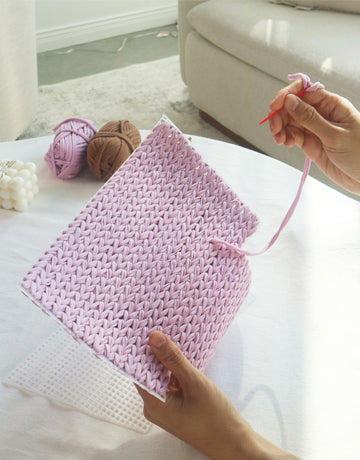

A beginner knitting kit is the perfect starting point for anyone who has ever seen a gorgeous, chunky-knit scarf and thought, "I wish I could make that." It's a curated box that removes the guesswork, bundling everything you need—the right yarn, the perfect needles, and easy-to-follow instructions—so you can dive straight into the fun part: knitting. This guide will walk you through what to look for in a kit, how to master your first stitches, and the essential tools you'll need to begin your crafting journey with confidence.
What's Inside a Beginner Knitting Kit?

Opening your first beginner knitting kit is an exciting moment. Instead of getting lost in a craft store aisle, you have a perfectly curated box of goodies designed to get you from zero to your first finished project. A quality kit is thoughtfully designed to set you up for success.
Core Components: Yarn and Needles
Every good kit starts with two things: the yarn and the needles. These are chosen specifically for beginners.
- Yarn: Most starter kits come with a chunky or bulky weight yarn (Weight 5 or 6). The thickness makes your stitches large and easy to see, which simplifies spotting mistakes and understanding how the fabric is formed. The fiber is typically a smooth 100% acrylic or a gentle wool-acrylic blend. These fibers are forgiving, don't split easily, and hold up well to being unraveled and re-knit as you practice.
- Knitting Needles: To match the thick yarn, the kit will have appropriately sized knitting needles, often 8mm (US 11) to 12mm (US 17). Bamboo or wood needles are ideal for beginners because their slight grip prevents stitches from accidentally slipping off—a common frustration.
Essential Tools and Notions
Beyond yarn and needles, a great kit includes several trusty sidekicks that make the process smoother.
| Tool | Purpose |
|---|---|
| Tapestry Needle | A blunt-tipped needle with a large eye used to weave in yarn ends for a polished finish. |
| Stitch Markers | Small plastic rings that clip onto your knitting to mark your place in a pattern, such as the start of a round. |
| Measuring Tape | A flexible tape measure is crucial for checking your gauge (stitches per inch) and ensuring your project dimensions are correct. |
| Pattern/Instructions | The most valuable component. A clear, step-by-step guide, ideally with links to video tutorials, turns a box of supplies into a successful project. |
A well-designed beginner kit removes frustration, allowing you to focus on the joy of creating. It builds a solid foundation for a hobby that can last a lifetime. If you're feeling inspired, check out other DIY craft projects to find your next creative adventure.
How to Choose the Right Beginner Knitting Kit

Picking your first beginner knitting kit should be exciting, not stressful. Let's break down what to look for to find the perfect match.
Choose a Project That Excites You
The best kit is one that helps you make something you're genuinely excited about. A quick, satisfying project is a huge motivation boost.
- Scarves & Dishcloths: These are perfect for practicing the basic knit stitch. As simple rectangles, they let you focus on building muscle memory.
- Simple Hats & Cowls: A great next step, these projects introduce knitting in the round on a straightforward project you can wear right away.
- Baby Blankets: If you have more patience, a baby blanket offers great practice for maintaining even tension over a larger piece of fabric.
Match Materials to Your Skill Level
The materials in your kit can make all the difference for a beginner.
- Needle Material: Bamboo or wooden needles are highly recommended. Their natural grip helps prevent stitches from slipping off. Metal needles are slick and fast, which is great for experienced knitters but can be difficult for newbies.
- Yarn Fiber and Weight: Look for kits with chunky or bulky weight yarn made from 100% acrylic or a wool-acrylic blend. These yarns are smooth, durable, and make stitches easy to see.
Choosing a kit with chunky yarn and bamboo needles is like learning to ride a bike with training wheels. It provides the stability you need to master the motions so you can focus on the pure joy of creating.
The craft world has seen kit sales jump by 35% year-over-year. A recent survey even found that 62% of new knitters finish their first project in a single weekend, showing just how effective a great kit can be. You can discover more about these knitting trends and what they mean for new crafters.
Ready for Your Next Crafting Adventure?
- Discover the elegance of our Stitch Mingle Leather Craft Bag Kits.
- Get creative with our colourful Stitch Mingle Plastic Canvas Kits.
- Explore our full range of DIY craft projects at Stitch Mingle.
How to Use Your Beginner Knitting Kit: A Step-by-Step Guide
Alright, you've got your shiny new beginner knitting kit in hand. Now the real fun begins. We’ll walk through making a simple garter stitch scarf—the perfect first project for building confidence one stitch at a time.
Step 1: Casting On
Before you can knit, you must get the yarn onto your needles. This starts with a slip knot and "casting on," which creates your first row of stitches.
- Make a Slip Knot: Create a loop with your yarn, then pull a second loop through the first to form a knot that slides to tighten. Place this loop on one needle and gently tug the yarn tails until it's snug but can still slide.
- Cast On: The "long-tail cast on" is a popular method that creates a tidy, stretchy edge. Using your thumb and index finger, you’ll form new loops and scoop them up with your needle. For a basic scarf, casting on 20 to 30 stitches is a great start.
This flowchart breaks down the basic journey of any knitted piece.

Step 2: The Knit Stitch
Once your stitches are on the needle, you’re ready for the most essential move: the knit stitch. Each time you complete this motion, you create a new loop, and your fabric will begin to grow. A classic rhyme helps beginners remember the four steps:
"In through the front door, Around the back, Peek through the window, And off jumps Jack."
- In through the front door: Insert the tip of your right needle into the front of the first stitch on your left needle.
- Around the back: Wrap the working yarn (from the ball) around the back of the right needle.
- Peek through the window: Guide that yarn wrap back through the stitch on the left needle.
- And off jumps Jack: Slide the original stitch off the left needle. You've made a knit stitch!
Repeat this for every stitch in the row. When you reach the end, swap the needles so the full one is back in your left hand and go again. Using only the knit stitch for every row creates a squishy, reversible fabric called garter stitch.
Step 3: Casting Off
When your scarf reaches the desired length, it’s time to "cast off" (or bind off). This secures your stitches so your work doesn’t unravel.
- Knit the first two stitches of your last row.
- Using the tip of your left needle, lift the first stitch up and over the second stitch, dropping it off the right needle. One stitch is cast off.
- Knit one more stitch. You will again have two stitches on your right needle. Repeat the process of lifting the older stitch over the newer one.
Continue until only one loop remains. Cut the yarn, leaving a six-inch tail. Pull the tail through the final loop to lock it. Use your tapestry needle to weave in the ends, and you’re done!
Explore More Creative Ideas
- Discover the satisfaction of guided making with our Stitch Mingle Leather Craft Bag Kits.
- Add a splash of colour to your life with our vibrant Stitch Mingle Plastic Canvas Kits.
- Find your next weekend hobby by browsing the bestsellers at Stitch Mingle.
Common Beginner Mistakes and How to Fix Them
Every knitter has dropped a stitch or created a weirdly tight row. These moments aren’t failures; they’re part of the learning process. With a few tricks, you can tackle any tangle and ensure the project from your beginner knitting kit turns out fantastic.
Fixing Uneven Tension
Is your knitting too tight or too loose? This is a tension issue, the most common hurdle for new knitters. Consistency is the goal.
- Knitting Too Tightly: Makes it hard to insert the needle and can cause hand strain. The Fix: Consciously relax your grip. Let the yarn glide smoothly through your fingers.
- Knitting Too Loosely: Creates floppy, messy stitches. The Fix: Try wrapping the yarn an extra time around your index or pinky finger to add more drag and control.
Don't be afraid to pull out a few rows. We knitters call it "frogging" because you have to "rip-it, rip-it!" It's better to fix a small section than to finish a project you don't love.
Handling Dropped Stitches
A dropped stitch—a lonely loop hanging a few rows below your needles—is completely fixable. A crochet hook is your secret weapon.
- Secure the Loop: Use a locking stitch marker or safety pin to stop the stitch from unraveling further.
- Get Behind the Work: From the back of your project, insert the crochet hook through the dropped stitch, from front to back.
- Climb the Ladder: Look for the horizontal "ladders" of yarn above the stitch. Use the hook to grab the lowest ladder and pull it through the loop.
- Repeat: Continue pulling each ladder through the loop until the stitch is back up to the current row. Place it back on your left-hand needle.
Once you master this, a dropped stitch becomes a minor, two-minute detour.
Explore Your Next Creative Project
- Ready for a stylish challenge? Check out our Stitch Mingle Leather Craft Bag Kits.
- Create unique home decor with our fun Stitch Mingle Plastic Canvas Kits.
- Find more crafting inspiration in our list of bestsellers at Stitch Mingle.
Beyond the Kit: Your Next Steps in Knitting
You did it! You’ve finished your first project, and it's the start of a wonderful journey. So, what’s next? It's time to meet the purl stitch.
The purl stitch is the mirror image of the knit stitch. Learning it unlocks a world of new textures. When you alternate knitting one row and purling the next, you create the famous stockinette stitch—the classic, smooth 'V'-stitch fabric seen on most sweaters.
Your Next Creative Projects
Once you're comfortable with both knit and purl stitches, you can tackle more exciting projects.
- A Ribbed Hat: Ribbing (alternating knit and purl stitches, like K2, P2) creates a stretchy fabric perfect for a snug hat.
- A Textured Baby Blanket: Play with texture by creating blocks of garter stitch (knitting every row) and smooth stockinette stitch.
Your knitting journey is a path of continuous discovery. Each new stitch and project adds to your skills, transforming you from a beginner into a confident maker.
As you grow, online communities and local yarn shops are amazing resources.
Got Questions? We’ve Got Answers
It’s normal to have questions when you’re just starting out. Here are some common ones.
What Is the Easiest Thing to Knit for a Total Beginner?
A simple garter stitch scarf is the best first project. You only need to learn the knit stitch and repeat it row after row. This repetition helps you build muscle memory and achieve even tension. If a scarf feels too long, square dishcloths or coasters are quick wins that boost confidence.
Are Wooden or Metal Knitting Needles Better for Beginners?
For almost all beginners, wooden or bamboo needles are the best choice. Their slightly grippy texture prevents stitches from sliding off accidentally. Metal needles are much slicker; while great for speed, that slipperiness can be hard for a newbie to control.
How Long Does It Take to Learn to Knit?
You can learn the basic knit stitch in under an hour. Most people can finish a small first project, like a dishcloth or a simple scarf, over a single weekend. The most important thing is to be patient and enjoy the creative process of making something with your own two hands.
Ready to start your own creative journey? Find the perfect, all-in-one project at Stitch Mingle and discover how easy and fun it is to make something you’ll love. Explore our beginner-friendly kits today!
Further Reading from Stitch Mingle: