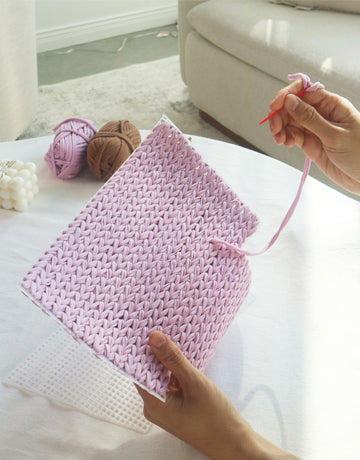

You start a striped project feeling confident, then hit that first colour change and suddenly the join looks jagged, the old yarn peeks through, and the neat picture in your head turns into a lumpy little mystery. That’s a normal crochet moment. Almost every crocheter has had it.
Changing colours in crochet gets much easier once you stop thinking of it as one skill. It’s really a set of choices. You need to know when to switch, where to switch, and which method suits the project in your hands. A flat striped scarf, a granny square, an amigurumi face, and a small bag don’t all behave the same way.
If you’re making garments, colour placement matters even more because every join becomes part of the finished look. That’s one reason it helps to study a clean project example like this crocheted women’s top pattern, where colour changes affect both shaping and style.
For newer makers, strong basics make everything else less stressful. If you want a refresher on hook control, stitch structure, and reading your yarn, this guide to crochet for beginners is a useful starting point before you tackle more colourful work.
Your Guide to Flawless Crochet Colour Changes
The first question isn’t “How do I pull in the new yarn?” It’s “When should the new colour appear?” That’s where beginners often get tripped up.
In crochet, the new colour usually enters before the stitch is fully finished. That feels backward at first, but it’s the key to cleaner results. The top of the stitch belongs to the colour you use in the final yarn over or pull-through. Once that clicks, messy joins start making a lot more sense.
Think in project types
Small projects each ask for something slightly different:
- Amigurumi needs control. You often want tiny colour areas, smooth curves, and very little bulk.
- Keychains need durability. The joins should stay tidy even if the item gets handled often.
- Bags need a method that won’t create weak spots or obvious shadows from carried yarn.
- Flat home décor or garments can use broader colour sections because the fabric has room to relax.
Practical rule: Change colour in the stitch before the new colour should show up.
Two moments matter most in changing colours in crochet. One is the end of a row, which is common for stripes. The other is mid-row, where you create motifs, shapes, letters, or small blocks of colour.
Once you can identify which of those moments your pattern uses, the mechanics become much less intimidating.
Planning When and Where to Change Colours
A clean result usually starts before the hook even moves. If you pause to plan your colour changes, you’ll avoid a lot of unpicking later.

End of row or middle of row
These are the two big decisions.
End-of-row changes are best for:
- stripes
- colour-blocked scarves
- blankets
- simple panels for bags
Mid-row changes are best for:
- hearts, flowers, and other motifs
- facial features on amigurumi
- checks, lettering, and picture-style crochet
- small shaped accents on pouches and accessories
If your pattern says the next row starts in a new colour, you’ll usually switch during the last stitch of the previous row. If the pattern shows a colour block appearing halfway across a row, you’ll switch in the last step of the stitch just before that block begins.
Read the pattern for timing, not just colour names
Many beginners scan for “pink” or “blue” and miss the stitch count that tells them where the switch belongs. Train your eye to look for both.
A helpful habit is to mark colour-change points before you start a row or round. You can do that with:
- A stitch marker placed in the stitch before the change
- A pencil note in the margin beside the row count
- A spoken check like “five stitches in cream, two in brown” before you begin
That little pause saves a surprising amount of frogging.
Palette planning matters more than people think
Colour choice isn’t only about taste. It also affects how tidy your joins look. High-contrast combinations, like black with white or deep red with pale beige, show every wobble more clearly. Soft contrast can be more forgiving when you’re practising.
A granny square is a good example. A multi-colour granny square probability analysis found that using 4 different yarn colours creates 11,880 possible combinations, and across 24 squares there was a 65% probability of at least one unwanted duplicate colour pair appearing. That’s a strong argument for planning your palette before you begin, especially if you want a project to look intentional rather than random.
If your project has many repeated units, don’t pick colours one square at a time and hope they balance out. Lay out the sequence first.
A simple planning method for beginners
Try this before you crochet:
| Step | What to decide | Why it helps |
|---|---|---|
| 1 | Project type | Tells you whether bulk, stretch, or neat edges matter most |
| 2 | Colour placement | Prevents accidental clusters or awkward repeats |
| 3 | Change points | Helps you spot where the new colour should enter |
| 4 | Tail strategy | Tells you whether to carry, cut, or weave later |
For a small bag, you might choose long horizontal stripes and end-of-row changes. For an amigurumi mushroom cap, you might choose short spots of colour and mid-round changes. For a keychain face, you might skip carrying yarn and use small separate lengths so the front stays crisp.
Match the method to the scale
Small projects punish bulky joins. Large flat projects forgive more. That’s why a technique that works beautifully on a blanket may look clumsy on a tiny crochet charm.
When you’re deciding where to change colours, ask yourself one practical question: Will this area be looked at up close? If the answer is yes, your method should favour neatness over speed.
The Three Core Techniques for Joining New Yarn
Most colour changes come back to three dependable methods. Once you understand these, you can handle a huge range of beginner and intermediate projects with confidence.

Changing colour on the last yarn over
This is the workhorse method for changing colours in crochet. It’s the one you’ll use most often.
The principle is simple. You work the current stitch until the final step, when there are still loops left on the hook. Then you use the new colour to finish that stitch. That makes the top of the stitch match the new section.
A 2024 survey of 150 intermediate crocheters found that this method had a 92% success rate for smooth transitions when tension was maintained properly. That’s one reason so many teachers start here.
How to do it mid-row
Use this for motifs, little shapes, or small colour blocks.
- Insert your hook into the stitch with the old colour.
- Yarn over and pull up a loop.
- Stop before the final pull-through.
- Drop the old colour.
- Yarn over with the new colour.
- Pull through the remaining loops.
- Crochet the next stitch fully in the new colour.
For a single crochet, that means changing when two loops remain on the hook. For taller stitches, the same idea applies. You switch on the final yarn over that completes the stitch.
Watch the top “V” of the stitch, not just the yarn in your hand. The top of the stitch tells you whether the colour change happened at the right moment.
How to do it at the end of a row
The same principle works for stripes.
On the final stitch of the row:
- work the stitch almost to the end
- use the new colour for the final pull-through
- chain and turn with the new colour if your pattern calls for it
This gives you a much cleaner row transition than finishing the whole stitch in the old colour and joining the new one afterwards.
Using a slip stitch join in the round
Joined rounds behave differently from continuous spirals. If your pattern closes each round, the join itself becomes part of the visual line, so you want it neat.
A slip stitch join is useful when:
- you’re making striped circles or hexagons
- each round is completed before the next begins
- you want a clear stopping point before changing colour
Basic sequence
- Finish the last stitch of the round, changing to the new colour in the final pull-through if needed.
- Insert your hook into the first stitch of the round.
- Pull the new colour through for a slip stitch.
- Start the next round according to the pattern.
This method creates an obvious round boundary, which many beginners find easier to manage than a spiral. It also makes counting simpler.
The trade-off is that the join can show if your tension changes suddenly. Keep your slip stitch relaxed enough that it doesn’t pinch the fabric.
Creating a seamless invisible join
When you want a polished finish, especially on decorative rounds, an invisible join can make a big difference. This is especially nice for motifs, coasters, or the visible top of a bag panel.
The idea is to finish the final stitch, fasten off, then use a yarn needle to mimic the top of a stitch where the join would normally show.
Why it looks cleaner
A standard slip stitch often creates a little bump. An invisible join blends into the edge so the round looks complete rather than “closed”.
This method shines when:
- the round will be visible from the front
- the colour change happens exactly at the join
- you’re taking photos of the finished piece
- the project has a tidy, graphic design
Here’s a video demonstration you can watch while practising the movement:
A quick decision guide
| Situation | Best core technique | Why |
|---|---|---|
| Stripe at row end | Last yarn over | Keeps the first stitch of the new row clean |
| Small motif in a row | Last yarn over | Precise and easy to repeat |
| Joined round | Slip stitch join | Defines the round clearly |
| Visible decorative round | Invisible join | Reduces the look of a seam |
What beginners usually feel with their hands
Sometimes instructions sound clear until the yarn is on the hook. Then everything feels crowded.
If that happens, slow down and focus on these physical cues:
- If the loops feel tight, the new colour may drag the old stitch out of shape.
- If the old yarn tail flops forward, it may show on the front.
- If the first stitch after the change looks loose, your new yarn probably needs a gentle snug, not a hard tug.
You’re aiming for control, not force. A firm but relaxed yarn hand makes cleaner joins than pulling hard at every switch.
Tapestry Versus Intarsia Crochet A Comparison
When a project uses multiple colours in the same row or round, the next decision is bigger than just where to switch. You need to choose how the unused colour will travel.

What makes them different
Tapestry crochet carries the unused yarn inside the stitches. You crochet over it so it moves with you across the fabric.
Intarsia crochet uses separate yarn sources for each colour block. Instead of carrying the unused colour all the way across, you leave it at the edge of its section and pick up the next bobbin or strand when needed.
That single difference changes the look, thickness, and behaviour of the fabric.
Tapestry works best for dense, structured pieces
Tapestry is handy for:
- repeated small motifs
- geometric patterns
- sturdy pouches and bags
- projects where a denser fabric is welcome
But it has limits. A 2015 Canadian amigurumi investigation by PlanetJune found that standard stitch bias in spiral crochet is about 1 stitch per 5 rounds, while tapestry crochet intensified that slant to 1 stitch every 2 rounds. The same investigation found tapestry distorted patterns 2.5 times faster than other methods in that context, making it a poor choice for vertically stacked colour blocks in spiral amigurumi.
That matters if you’re making eyes, shirt stripes, or tidy vertical shapes on a stuffed toy. The carried yarn may be manageable, but the visual slant can fight your design.
Intarsia suits larger colour blocks
Intarsia is often the better choice for:
- big patches of colour
- picture-style crochet
- front panels with clear shapes
- projects where you don’t want carried yarn shadowing through
The downside is yarn management. Instead of one working strand and one carried strand, you may have several small bobbins hanging from the work. It can feel fiddly, but the fabric usually stays more flexible and less bulky.
If the colour section is small and repeated often, carrying yarn may be worth it. If the section is large and isolated, separate bobbins usually look better.
Tapestry vs. Intarsia Crochet Which to Choose
| Factor | Tapestry Crochet | Intarsia Crochet |
|---|---|---|
| Yarn handling | Carries unused colours within stitches | Uses separate yarn sources for each block |
| Fabric thickness | Denser and thicker | Closer to normal fabric thickness |
| Best for | Small repeated motifs, structured items | Large colour blocks, picture-style sections |
| Back of work | Neater and more enclosed | Can look looser but avoids long carries |
| Stretch | Often less stretchy | Usually more pliable |
| Small amigurumi details | Can skew in spiral work | Often cleaner for distinct shapes |
| Yarn waste | Less cutting, fewer separate tails in some projects | More bobbins and more tail management |
How this choice affects small projects
For amigurumi, tapestry can seem tempting because carrying yarn reduces tails. But if the design relies on stacked colour sections, the slant can become obvious. For tiny toys, many crocheters get a cleaner result by using separate lengths of yarn or carefully placed surface details instead.
For keychains, think about handling. A firm fabric is useful, so tapestry can work for geometric details. But if the keychain has a face or a simple icon with separate patches, intarsia-style sections may look sharper.
For bags, tapestry can be excellent when you want structure. Intarsia may be the better fit for a front panel with a bold shape or large lettering.
The real beginner question
A lot of new crocheters ask, “Which one is easier?” The honest answer is that tapestry is easier to start, but intarsia is often easier to make look clean when the design has bigger colour blocks.
So the better question is, “Which one will make this specific project look better?” That shift in thinking saves frustration.
The Art of a Tidy Finish Weaving In Ends Securely
A beautiful colour change can still fail at the finishing stage. If the tails work loose, peek through, or create lumps, the whole project looks less polished.

Don’t assume crocheting over tails is always enough
Crocheting over tails can save time, and for some low-stress areas it’s perfectly fine. But for items that get handled a lot, like toys, bag charms, and practical accessories, that shortcut isn’t always secure enough on its own.
A 2025 report on washable yarn trends in Canada noted a 15% rise in washable yarn sales, and the same source recommends weaving ends in three different directions for durable joins: horizontally, vertically, then horizontally again. That matters for colour-changed pieces that may go through a wash cycle.
A stronger method for real-life use
Try this with a yarn needle:
- First pass. Weave the tail horizontally through the backs of several stitches.
- Turn direction. Move vertically through the fabric structure.
- Lock it in. Weave horizontally again in the opposite direction.
That path creates friction from more than one angle, so the tail is less likely to wriggle loose.
A tidy finish isn’t just about appearance. It’s what keeps a giftable project looking good after use.
Match the finish to the object
Different projects need different finishing choices.
- Amigurumi often hides tails inside the stuffing area, but they still need to be secured first.
- Keychains benefit from extra-secure weaving because they’re touched, swung, and rubbed against bags and pockets.
- Flat pieces can often hide tails neatly on the wrong side, unless they’re reversible.
- Bags need smooth inner surfaces, so bulky knots are best avoided.
If you need a simple refresher on ending yarn neatly before weaving, this guide on how to fasten off crochet walks through the basics clearly.
When to trim the tail
Don’t trim too early. After weaving, give the fabric a gentle stretch in both directions first. If the tail shifts, weave a bit more. If it stays put, trim it close enough to hide but not so close that it slips back out immediately.
A small, careful finish nearly always looks better than a rushed one.
Common Colour Change Mistakes and How to Fix Them
Most colour-change problems have a visible clue. If you learn to match the clue to the cause, fixing the issue gets much easier.
The old colour peeks into the new section
What it looks like: a little dot or line of the old yarn appears at the top of the first stitch in the new colour area.
Why it happens: the colour was changed too late. The old yarn finished the stitch instead of the new yarn doing the final pull-through.
Fix: switch on the last yarn over or final pull-through of the stitch before the new colour begins. Then make the next stitch fully in the new colour.
The join looks tight or puckered
What it looks like: the fabric pinches inward where the colour changes.
Why it happens: the new yarn was pulled too tightly, or the carried strand has no give.
Fix: after completing the first stitch in the new colour, gently smooth the fabric and adjust the unused strand before continuing. Aim for even tension, not a hard pull.
There’s a gap at the colour change
What it looks like: a tiny hole where the two colours meet.
Why it happens: the old yarn was dropped too loosely, or the new yarn wasn’t anchored with enough control.
Fix: snug the old and new tails lightly after the first stitch or two. Don’t yank. A small adjustment is usually enough.
Stripes or blocks slant in spiral rounds
What it looks like: the colour change shifts sideways as the rounds build.
Why it happens: spiral crochet naturally travels. If you’re working stacked colour sections, the slant becomes obvious over time.
Fix: for projects where straight vertical colour placement matters, consider a method better suited to that design, such as joined rounds or separate colour sections instead of carried spiral colourwork.
The yarn itself causes trouble
Not every messy colour change is a technique problem. Sometimes the yarn is the issue.
A 2025 analysis of Canadian crafting forums and survey data found over 1,200 posts about colour bleeding and dye lot matching in locally sourced yarns, and 28% of Canadian crafters reported yarn quality issues in multicolour projects. If one shade feels thinner, fuzzier, or more slippery than the next, your neat technique may still produce an uneven result.
What helps in practice
- Check dye lots before starting if colour consistency matters.
- Test dark and light shades together on a small swatch if you suspect bleeding.
- Watch your yarn grip when fibres behave differently. This guide on how to hold yarn when crocheting can help if your tension changes during joins.
- Save a sample strand from each yarn used, especially for kits, gifts, or matching repairs later.
Most messy joins aren’t failures. They’re feedback. The fabric is telling you whether the timing, tension, or yarn choice needs adjusting.
Start Your Colourful Crochet Adventure Today
The nicest part about changing colours in crochet is that the skill grows quickly once you match the method to the project. A stripe teaches timing. A granny square teaches planning. A tiny amigurumi detail teaches precision. A bag panel teaches you when structure helps and when it gets in the way.
If you’re still building confidence, start small. Small projects let you repeat the same colour change several times without committing to a huge blanket or garment. That repetition is where the technique starts to feel natural.
Good first projects for practice
A beginner-friendly colour practice list might look like this:
- Simple striped swatches for learning row-end changes
- Small circles or coasters for trying joined rounds
- Mini amigurumi details for controlled mid-row changes
- Basic geometric panels for deciding between tapestry and intarsia
Each one teaches a different part of the decision-making process, which is what really improves your finish.
Choose projects that let you see the result clearly
A small object is ideal because you can notice exactly what each choice does. If you carry yarn, you’ll see the added density. If you switch on the wrong stitch, you’ll spot the colour jump right away. If you weave tails properly, the project keeps its shape and looks tidy after handling.
That’s also why decorative pieces can be surprisingly useful practice. If you’d like inspiration for a project where colour placement really stands out, this guide to a crochet wall hanging shows how crochet colour choices can become part of the display itself.
Keep your expectations realistic
Your first colour changes probably won’t all look identical. That’s fine. What matters is that you can now identify the moment of the change, choose a suitable method, and fix common issues before they turn into a whole-project problem.
A confident crocheter isn’t someone who never makes a messy join. It’s someone who knows why it happened and what to change next time.
When you practise with manageable projects, your hands learn faster than you think they will. Soon you won’t be guessing whether to carry, cut, join, or weave. You’ll recognise the right choice almost immediately.
If you’re ready to turn these techniques into a finished project, Stitch Mingle is a lovely place to browse beginner-friendly DIY kits and accessories. Small, guided projects are perfect for practising neat joins, tidy finishes, and confident colour choices without feeling overwhelmed.