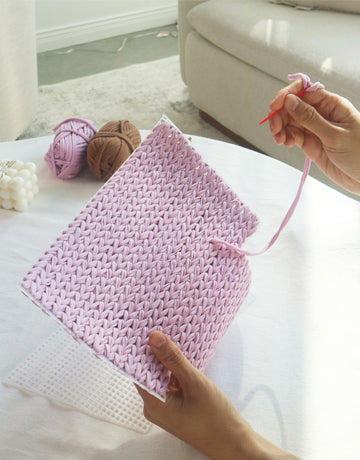

You’re probably here because a starting chain has betrayed you.
You crochet the first row of a scarf, bag panel, or blanket strip, hold it up, and the bottom edge is tighter than the stitches above it. It puckers. It curves. It feels stiff in your fingers while the rest of the fabric feels soft and flexible. That mismatch is one of the most common reasons a project looks awkward before it’s even had a fair chance.
Foundation double crochet fixes that problem in a surprisingly elegant way. Instead of making a long chain first and then forcing a row of double crochet into it, you build the foundation chain and the first row of double crochet at the same time. The result feels more like the rest of your fabric. It stretches better, sits flatter, and often makes stitch counting easier too.
If you’ve ever avoided garment necklines, blanket borders, or bag bases because the first row felt fiddly, this stitch is worth learning. It’s one of those techniques that can make crochet feel less like wrestling and more like rhythm.
Unlock Perfect Project Starts with Foundation Double Crochet
You cast on for a baby blanket from a beginner kit, crochet a few rows, and the very first edge already feels wrong in your hands. The stitches above are soft and flexible. The bottom edge feels like a cord.
Foundation double crochet helps you avoid that problem from the start.
If you already know how a basic crochet chain stitch is formed, you have the background you need. FDC changes the feel of the starting edge because you build the base and the first row together, with the same hand motion and nearly the same tension. Instead of making one tight chain and then trying to loosen up for the next row, your hands settle into one rhythm.
What foundation double crochet actually is
Foundation double crochet, usually shortened to FDC, is a chainless foundation stitch. Each new stitch does three jobs at once:
- creates the base
- forms the double crochet stitch
- keeps the lower edge closer in feel to the fabric above it
That tension match is the part beginners often notice first. A regular starting chain can tighten up without you realizing it, especially if you are concentrating on counting. FDC works more like laying train track as the train moves forward. Each stitch is added in sequence, so the base grows with the row instead of sitting underneath it as a separate, tighter strip.
Why the feel matters in real projects
This stitch is easier to appreciate with your fingers than with a definition.
A good FDC row feels springy and even. If you pinch the edge, it has some give. If you spread the fabric a little, the stitches open in a consistent way instead of pulling hard in one section and sagging in another. That is why FDC is so helpful for projects where comfort and shape matter at the same time.
It can make a blanket edge lie flat instead of curving upward. It can give a sweater neckline enough stretch to go over the head without feeling floppy later. It can also make the first row in beginner-friendly kits less frustrating, because your starting edge behaves more like the fabric you are trying to make.
Here’s where I see it pay off most often:
- Blankets, where an even foundation helps the edge stay flat
- Sweater necklines, where a little stretch makes the fit more comfortable
- Scarves and cowls, where you want softness right from the first row
- Bag panels, where you need flexibility without a harsh, tight base
A foundation row should feel like it belongs to the fabric.
If yours feels stiff, wiry, or smaller than the stitches above it, that is useful feedback, not failure. The yarn is telling you your tension changed. Once you learn that feel, FDC becomes much easier to control, and your projects start cleaner, flatter, and with far less wrestling at row one.
Comparing Foundation Double Crochet and Traditional Chains
You can feel the difference between these two starts before you can always explain it.
A traditional chain often feels like a narrow cord sitting under your fabric. Foundation double crochet feels more like the first row already belongs to the piece. For beginners, especially those working from kits, that difference shows up fast. The edge stays easier to handle, the stitch size is easier to match, and you spend less time wrestling with a starting chain that got tighter than you meant it to.

Side by side differences
| Attribute | Foundation Double Crochet (FDC) | Traditional Chain + First Row |
|---|---|---|
| Setup | Builds the foundation and first row together | Requires one chain row, then a separate stitch row |
| Stretch | More elastic and closer in feel to the fabric above | Often tighter than the rest of the project |
| Tension | Easier to keep consistent because each stitch is formed in sequence | Chains are often worked at a different tension from stitches |
| Counting | Stitch count is usually easier to check as you go | Easy to miscount the initial chain or skip a chain later |
| Feel in the hand | Softer, more fluid, less rigid | Can feel wiry or tight at the edge |
| Best use | Garments, blankets, scarves, flexible bag edges | Projects that specifically require a chain start |
Why FDC often feels easier
The main advantage is rhythm.
With a traditional start, you make a long chain first, then go back and work into it. That sounds simple, but it asks your hands to do two different jobs at two different tensions. Many crocheters chain tightly, then loosen up once they begin the first real row. That is how you end up with a blanket edge that curves, or a sweater neckline that feels snug before you have even tried it on.
FDC keeps the lower chain portion and the double crochet portion connected as you work. The stitches build one by one, almost like stacking matching blocks instead of attaching fabric to a string. That makes it easier to notice tension changes right away and correct them before they travel across the whole row.
What that means in real projects
For a blanket, FDC often gives you a starting edge that lies flatter and looks more even from corner to corner.
For a sweater neckline, it can give you enough stretch to pull the garment on comfortably without leaving the edge loose or floppy later.
For beginner-friendly kits, it removes one of the most common early frustrations. You are not trying to insert your hook into a row of tiny chains that twist, hide, and tighten up under pressure. You are working into stitches that are easier to see and easier to count.
When a traditional chain still makes sense
A plain chain is still useful in some patterns, and it is worth keeping in your toolkit.
- Pattern-specific starts when the design tells you to work into selected chains, skips, or special placements
- Decorative chain edges when the visible chain is part of the look
- Very structured pieces where you want a firmer lower edge on purpose
If you want to compare the feel in your own hands, make a short swatch both ways with the same yarn and hook. Tug gently on the edge, lay it flat on a table, and notice which one behaves more like the fabric above it. If you want a refresher first, this guide to the chain stitch crochet method is a helpful reference.
If you want a soft, even starting edge that behaves like the rest of your fabric, FDC is usually the better choice.
Mastering the Foundation Double Crochet Stitch
You sit down to start a blanket from a beginner kit, chain carefully, and by stitch twelve the edge already feels tight and uneven. Foundation double crochet changes that starting experience. Instead of building a long chain first and hoping your tension stays friendly, you build the edge and the first row at the same time, so your hands can feel right away whether the fabric is soft, stretchy, and flat.

Many beginners find FDC easier once they realize they are making two connected parts in one motion. A small chain forms the base, then a double crochet grows on top of it. If you have ever felt lost in a row of tiny starting chains, this often feels much more readable in your hands.
Before you begin
You only need yarn and a hook, but the feel of your grip matters as much as the steps.
Hold your hook the way you normally do, then relax your fingers by one notch. That small change gives the bottom chain room to stretch. If you squeeze near the hook, the base of each stitch can shorten and the whole edge starts behaving like a drawstring.
If you want a quick refresher on the top half of the stitch, this guide to the double crochet stitch is useful, because FDC finishes the same way a regular double crochet does.
The first stitch step by step
Some crocheters start with chain 2. Some use chain 3. Either way, your goal is the same. Create one base chain, then complete one double crochet on top of it.
Step 1 with the slip knot and starter chain
Make a slip knot and place it on your hook. Chain 2 or 3, depending on the method you are following.
Keep those starter chains relaxed. They are just a launch point for the first stitch, not the full foundation row.
Step 2 make the setup loop
Yarn over. Insert your hook into the first chain, or into the back bump if that helps you see the structure more clearly. Pull up a loop.
You should now have three loops on your hook. Pause for a second. If the yarn already feels tight or your hook does not glide easily, loosen now rather than hoping it sorts itself out in the next step.
Step 3 create the bottom chain
Yarn over and pull through one loop only.
This is the part that makes FDC click. That single pull-through creates the little chain at the bottom of the stitch. It becomes the entry point for the next foundation stitch.
A helpful habit is to let that loop sit slightly taller on the hook before you pull through. The extra height gives you a softer, more flexible edge, which is exactly what helps blanket bottoms lie flat and sweater necklines stretch comfortably.
Step 4 finish the double crochet
Yarn over and pull through two loops. Yarn over and pull through the final two loops.
You have made your first foundation double crochet.
How to recognize the parts you just made
Before you rush into the next stitch, turn the work a little and look at what is in your hand.
You are looking for two landmarks:
- The top V, which looks like the top of a regular double crochet
- The lower chain or V, which sits underneath and becomes the place for your next insertion
The lower chain is the piece beginners often miss at first. Once you can spot it quickly, the stitch feels far less confusing.
Repeat the stitch without losing your place
For each new FDC:
- Yarn over
- Insert your hook under both strands of the lower V from the previous stitch
- Pull up a loop
- Yarn over and pull through one loop to form the new bottom chain
- Yarn over and pull through two
- Yarn over and pull through two again
Say the rhythm if that helps. “Insert, pull up, through one, through two, through two.” Your hands learn FDC faster when the motion has a steady beat.
What the stitch should feel like
FDC is easier to learn when you judge it by touch, not just by appearance.
A good row feels springy at the base and smooth on the hook. If your hook starts fighting you, or if each new insertion feels tighter than the last, the lower chain loops are probably shrinking. That is your cue to make the chain-forming loop a little taller and soften your grip.
This matters in real projects. A foundation row with balanced tension gives beginner-kit blankets cleaner edges and helps wearable pieces start with stretch that feels comfortable instead of stiff.
Here’s a visual guide if you’d like to watch the motion in real time:
A simple counting habit that prevents trouble
It is easy to count the starter chain by mistake, especially in the first few stitches.
Keep counting simple:
- Count only completed FDC stitches
- Ignore the starter chain
- Place a marker every few stitches if the row is long
- Count the top V's, not the twists at the bottom
If a pattern says 10 double crochet in the first row, you will usually make 10 FDC, not a chain plus 10 double crochet into it.
Work slowly for the first five stitches. Speed usually shows up on its own once your hands recognize the lower chain.
A practice exercise that helps
Do not test this on a huge project first. Make a tiny swatch and let your fingers learn the structure.
Try this:
- Chain your starter
- Make 10 foundation double crochet
- Stop and inspect the row
- Gently stretch it
- Count the top stitches
- Crochet one regular row of double crochet on top
That quick practice tells you a lot. If the edge opens slightly when you tug it and settles back into shape, your tension is in a good place. If it curls, stiffens, or becomes hard to work into, your lower chain loops need a bit more space. That small adjustment is often the difference between a neat, easy project start and a row you want to frog.
Fixing Common Foundation Double Crochet Problems
You start a blanket from a beginner kit, the first row looks neat for three stitches, and then the edge begins to curl in your hand. Or you try the neckline of a simple sweater, and the row feels stiff instead of softly stretchy. That frustrating feeling usually comes down to tension in the lower chain portion of each FDC, not the whole stitch.

FDC problems tend to show up in ways you can feel before you even measure them. A good row has a little spring. It bends without fighting you. It stretches, then settles back into place, which is exactly what helps blanket edges lie flat and sweater openings stay comfortable instead of pinching. Interweave’s guide to foundation double crochet stitch structure and placement is helpful if you want a visual reference for where the stitch is built.
Why is my foundation edge curling
Curling usually means the chain part at the bottom of each stitch is shorter than the double crochet sitting on top of it. The top has room. The bottom does not. The row pulls inward like a waistband with the elastic drawn too tight.
Try this small adjustment. After you pull up a loop, let it sit slightly taller on the hook before you yarn over and pull through one. That extra height gives the lower chain enough room to flex.
If you are using smooth cotton from a beginner kit, this difference is easy to feel. The stitch should slide, not scrape.
Fix it like this:
- Pull up your working loop a little taller than usual
- Relax your grip before the pull-through-one step
- Check whether the bottom edge can stretch gently between your fingers
- If it still curves, go up one hook size for practice swatches
Why are there gaps between stitches
Gaps often come from stitching into the wrong part of the previous FDC. Many beginners aim too high and catch the side of the stitch instead of the lower V or bottom chain.
The easiest way to spot the correct place is to tip the work toward yourself and look for the little horizontal base under the top V. Once your eyes learn that shape, the row starts to make more sense.
A shorter foundation stitch can make this easier to see while you practice. If you want a simpler structure first, foundation single crochet for beginners gives you the same built-in foundation idea with less height to manage.
Why does the row feel uneven
Uneven rows usually come from changing hand pressure as you work. Many crocheters begin carefully, loosen up after a few stitches, then tighten again when they stop to check the stitch. Your yarn feed changes, and the row records every shift.
Treat the first ten stitches like tuning a guitar string. You are not only making loops. You are adjusting how much resistance the yarn gives your fingers.
Try this reset:
- Make three FDC stitches
- Lay them flat without stretching them
- Compare the height of the posts and the width of the lower chain
- Loosen the yarn feed if one stitch looks pinched
- Continue with the same hand position for the next three stitches
Slow and even beats fast and tense.
What if I keep losing the next insertion point
That is a normal beginner problem, especially with darker yarns or splitty fibers. FDC asks you to read two layers at once. You are looking for the stitch top and the built-in chain below it.
A few practical tricks help right away:
- Use light or medium solid yarn so the lower loops stand out
- Skip fuzzy or halo yarns until the stitch shape feels familiar
- Pinch the last completed stitch at the base to separate the lower V from the post
- Place a marker in the newest stitch if you pause often
Sometimes the best fix is tactile, not visual. Run your thumbnail lightly along the bottom edge. You can often feel the next insertion point before you can clearly see it.
Quick problem and fix guide
| Problem | Likely cause | Quick fix |
|---|---|---|
| Curling edge | Bottom chain loop is too short | Pull up a taller loop before the pull-through-one step |
| Visible gaps | Hook inserted into the side of the stitch instead of the lower base | Insert under the lower V or bottom chain of the previous FDC |
| Stiff row | Overall tension is too tight | Loosen your yarn hold and let the stitch move freely on the hook |
| Uneven height | Hand tension changes mid-row | Pause every few stitches and compare the posts before continuing |
| Wrong stitch count | A stitch was skipped or the structure got hard to read | Mark every few stitches and count only completed FDCs |
The good news is that FDC usually tells you what is wrong early. If the row feels stretchy, even, and easy to work into, you are on the right track. If it feels tight, wavy, or hard to read, your hands just need a small adjustment. That is very common, and it gets better fast with one or two short practice strips.
Beyond the Basics with FDC Variations and Shaping
Your first few rows with foundation double crochet probably felt like learning to pat your head and rub your stomach at the same time. Then your hands started to recognize the rhythm. That is the point where FDC becomes more than a clever way to skip a starting chain. It becomes a shaping tool.

Its main benefit becomes clear in how the edge feels. A regular chain can act like a tight waistband at the bottom of your fabric. FDC has more give, so curves open more naturally and straight edges stay flatter. In practical terms, that can mean a blanket edge that does not flare at one corner and a sweater neckline that stretches comfortably instead of feeling stiff against the skin. That soft, flexible start is especially helpful in beginner-friendly kits, where even tension matters more than speed.
Other foundation stitches you’ll meet
Once your fingers understand the FDC motion, the other foundation stitches make more sense because the structure is the same. You are building the base and the first row together, just at a different height.
The main variations are:
- Foundation single crochet for firmer, lower-profile starts
- Foundation half double crochet for a middle ground between structure and drape
- Foundation double crochet for a taller, stretchier start
If you want to compare the shorter version, this walkthrough on foundation single crochet pairs nicely with FDC practice.
How to increase in foundation double crochet
An increase in FDC means making two stitches from the same foundation point. The mechanics are simple. The feel is what keeps the edge neat.
Work your first FDC as usual. Then go back into that same lower V or base loop and make a second FDC there. If the spot feels crowded under your hook, pause and loosen the base loop with your fingertip before finishing the second stitch. That tiny adjustment often keeps the edge from puckering.
This is useful for:
- Bag bases that widen gradually
- Curved neckline sections
- Rounded starts on accessories
A good increase feels like two stitches sharing space, not fighting over it. If the fabric starts to cup or ripple right away, the lower chain part of one or both stitches is probably too short.
How to decrease in foundation work
Foundation decreases confuse many crocheters because there is less visual space to hide mistakes. In a regular row, you can see the top loops clearly. In a foundation row, you are managing the post and the base at the same time.
For that reason, many beginner patterns use FDC for the stretchy starting edge, then place decreases in the next row where the stitch tops are easier to read. That is often the cleaner choice for sweater necklines, tapered panels, and simple kit projects.
If a pattern does ask you to shape directly in the foundation row, work slowly and check the bottom edge with your fingers after every few stitches. It should feel smooth and evenly spaced, not pinched. A pinched section usually turns into a visible wave once the next row is added.
Avoiding rippling in shaped edges
Rippling usually comes from one of two things. The increases are too close together, or the base loops vary in size from stitch to stitch.
Here is a practical way to check your work before the problem grows:
- lay the row on a table after each shaping section
- run a finger along the lower edge
- compare how wide each base loop feels
- redo the section early if one area feels tighter or fuller
This is one of those places where touch beats sight. Your hands notice bunching before your eyes do.
If you are making a baby blanket from a kit, this helps the edge stay flat enough for a simple border later. If you are starting a pullover neckline, it helps the opening keep its stretch without turning wavy. That is why shaping with FDC is worth practicing. You are not only learning where to place the hook. You are learning how to control the fabric from the very first row.
Simple Projects to Showcase Your New FDC Skills
The best first FDC projects are small enough to finish without boredom and useful enough that you’ll notice the benefit of the stitch straight away.
A stretchy headband
A headband is almost a perfect FDC exercise. The starting edge needs give, and you can feel the difference immediately when you pull it around the head.
If you began with a regular chain and worked too tightly, the edge would feel firm and less comfortable. FDC creates a softer base that behaves more like the rest of the fabric.
A simple dishcloth or face cloth
A square cloth lets you focus on one thing: whether the foundation edge stays flat.
This is a nice confidence builder because the shape is simple. You can study the lower edge, compare it with the top edge when finished, and get a clear sense of how your tension is improving.
A scarf with a relaxed drape
Scarves are one of the most satisfying places to use foundation double crochet. The opening edge doesn’t pull in, and the whole piece starts with a more fluid feel.
That’s especially helpful if you dislike counting a long chain and then working into it without twisting or missing stitches.
A small basket or pouch base
A compact pouch or soft-sided basket gives you practice with a foundation row that needs some flexibility but still has shape. It’s a good bridge between simple flat work and more structured accessories.
The tactile lesson here is useful. You learn how FDC can be soft without being floppy.
A bag panel or accessory strip
If you want to practise for more polished handmade accessories, make a small rectangular panel first. Use FDC for the base, then add regular rows above it. You’ll see how the foundation edge supports the piece without locking it into stiffness.
That skill transfers nicely to beginner-friendly DIY kits and giftable accessories. A neat, flexible starting edge can make handmade pieces feel more finished from the start.
Frequently Asked Questions about Foundation Stitches
Can I use foundation double crochet with any yarn weight
Usually, yes. The method works across many yarn types, but beginners often find smooth, lighter-coloured yarn easier because the lower chain is more visible. Very fuzzy or dark yarn can make the insertion point harder to see.
How do I count FDC stitches correctly
Count the completed top V stitches, not the starter chain. If you’re making a long row, place stitch markers at regular intervals so you don’t need to recount from the beginning every time.
Do I replace the turning chain and first row with FDC
In most cases, yes. If a pattern begins with a number of double crochet stitches in row one, you typically make that same number in foundation double crochet. Always check whether the designer has any special setup instructions.
Can I join foundation double crochet in the round
You can, but it helps to work the row carefully first and make sure it isn’t twisted before joining. Many crocheters prefer to master FDC flat before trying it in the round.
What’s the biggest beginner mistake
Most beginners either make the lower chain part too tight or lose track of where to insert the hook for the next stitch. Slow down, look for the lower V, and keep that chain-forming loop slightly taller than feels natural at first.
Is foundation double crochet better than a regular chain every time
Not every time. Some patterns need a standard chain for design reasons. But when you want a stretchy, even, comfortable starting edge, FDC is often the better choice.
If you’re ready to turn your new crochet confidence into a finished project, have a look at Stitch Mingle. Their beginner-friendly DIY kits make it easy to create polished, giftable accessories with clear instructions, quality materials, and projects you can finish without hunting down extra supplies.