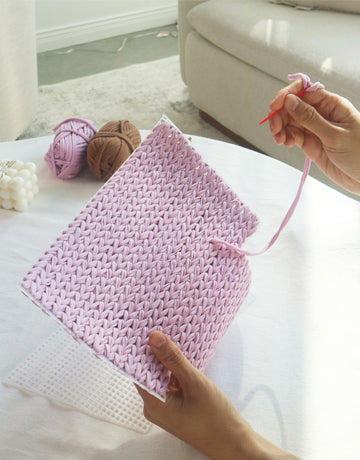

You’ve probably seen a star crochet blanket online and thought the same thing many beginners think. It looks gorgeous, dramatic, and far too complicated for a first large project.
That reaction makes sense. A star shape looks more advanced than a rectangle, and the pointy edges can make the pattern seem mysterious. But this is one of those projects that looks harder than it is. Once you understand how the centre grows and where the points and valleys go, the whole blanket starts to feel wonderfully repetitive.
Your Journey to a Stunning Star Blanket
A star crochet blanket is a lovely first “big” make because it gives you visible progress fast. Every round changes the shape in a way you can clearly see. That matters when you’re still building confidence, because it’s easier to stay motivated when your work already looks special after the first few rounds.
There’s also real proof that an everyday crafter can finish one on a normal schedule. In Hanford, California, Genna from Crochet by Genna completed a viral 6-Day Star Blanket in exactly six days during the 2024 to 2025 holiday period, documenting the process in a time-tracked YouTube vlog about her 6-Day Star Blanket finish. That kind of example is encouraging because it shows the project can fit around real life, not just perfect craft-room conditions.

If you’re worried you’ll lose track of the pattern, you’re not alone. Most beginners don’t struggle because the stitches are impossible. They struggle because they don’t yet see the logic behind the shape. A star blanket works by building points and valleys in a predictable rhythm. Once that clicks, the pattern becomes much less intimidating.
What makes this project beginner-friendly
A few things help this design feel manageable:
- The shape grows in rounds so you don’t have to count long rows from edge to edge.
- Mistakes show up clearly because a point or valley will look “off,” which helps you catch problems early.
- The pattern repeats after the setup, so you spend less time learning and more time crocheting.
Practical rule: Don’t judge the whole blanket by the first round. The star shape becomes much clearer after the early setup rounds.
What to expect emotionally
Your first few rounds may feel slow. That’s normal.
Then something delightful happens. The centre starts to form, the points appear, and suddenly you’re not just practising stitches anymore. You’re making an actual blanket that looks intentional and impressive. That shift is often the moment beginners realise they can do far more than they thought.
If you can make a chain, work double crochet, and pause to check your stitch placement, you can make a star crochet blanket. Patience matters more than speed. Neatness improves as you go.
Gathering Your Tools and Yarn
Before you crochet the first stitch, make your supply choices easy on yourself. The right yarn and hook can turn this project from frustrating into satisfying.
One of the biggest beginner-friendly choices is using #5 bulky yarn with a 6.5mm hook. That combination helps the blanket work up faster, and for a standard 60-inch throw, the 6-Day Star Blanket can be completed in about 24 total hours, which is quicker than traditional afghans that can take 40 to 60 hours, according to Betty McKnit’s 6-Day Star Blanket guidance. Bigger yarn also makes the stitches easier to see, which is a huge help when you’re still learning where each stitch belongs.
The basic tool kit
You don’t need a huge pile of supplies. Start with these:
- Bulky yarn. A smooth, light-coloured yarn is easiest for beginners because the stitches are easier to count than dark or fuzzy fibres.
- 6.5mm crochet hook. This size pairs well with bulky yarn and helps the fabric move along quickly.
- Stitch markers. These are useful for marking the top of a point or the start of a round.
- Yarn needle. You’ll need this later for weaving in ends.
- Sharp scissors. Cleaner cuts make finishing tidier.
- A notebook or row tracker. Helpful if you stop and start often.
If you’d like a simple guide to choosing beginner-friendly craft supplies more generally, this overview of a crochet kit in Canada is useful for thinking about what makes a project easier from the start.
Choosing fibre without overthinking it
Different fibres change the experience of making and using your blanket.
| Fibre type | What it feels like to crochet | Why a beginner might choose it | Watch for |
|---|---|---|---|
| Acrylic | Smooth and forgiving | Affordable, easy-care, widely available | Can curl more in humid conditions |
| Wool blend | Springy with nice stitch definition | Helps points hold shape well | May need gentler washing |
| Cotton blend | Crisp and structured | Great stitch visibility | Can feel heavier in the hands |
Acrylic is often the simplest place to start. It’s practical for blankets and easy to find in many colours. If your hands get tired, though, a softer wool blend may feel gentler to work with.
Star blanket sizing and yarn requirements
Use this table as a planning guide rather than a strict formula. Different yarn brands, personal tension, and how many repeat rounds you add will all affect the final result.
| Blanket Size | Approx. Diameter | Yarn Needed (metres) | Recommended Hook |
|---|---|---|---|
| Baby blanket | Small | Varies by yarn and repeats | 6.5mm with #5 bulky yarn |
| Lap blanket | Medium | Varies by yarn and repeats | 6.5mm with #5 bulky yarn |
| Throw blanket | 60 inches | Varies by yarn and repeats | 6.5mm |
| Bedspread | Large | Varies by yarn and repeats | Adjust based on yarn behaviour |
Small decisions that make a big difference
Beginners often focus only on colour, but these details matter just as much:
- Pick a smooth yarn first. Novelty yarn can hide stitches.
- Buy enough from one dye lot if possible. Colour shifts are more obvious in large blankets.
- Test your hook with a small swatch. If the fabric feels stiff, go up slightly. If it feels floppy, try the stated hook again and check your tension.
A star blanket is easier when you can see the architecture of the stitches. Smooth yarn helps you read the pattern while you crochet.
Mastering the Core Stitches and Pattern
The most helpful way to learn a star crochet blanket is to separate it into two parts. First, learn the small stitch skills. Then learn how those stitches create the shape.
That approach keeps you from feeling swamped. You don’t need to memorise the whole blanket at once. You only need to understand the next move.

The stitches you need first
A typical star crochet blanket uses a small group of foundational skills.
Magic ring
The magic ring creates an adjustable centre. Instead of leaving a fixed hole in the middle, you pull the tail and close it snugly.
If this feels fiddly, that’s normal. Many beginners need a few tries before it feels natural. Hold the ring gently while you work your first stitches so it doesn’t collapse too early.
Chain stitch
The chain gives you height and spacing. In star blankets, chains often help define the corners or point tips.
Keep your chains relaxed. Tight chains make the centre pucker and can distort the early rounds.
Double crochet
The double crochet, often written as dc, does most of the shaping work. It builds height quickly, which is one reason this project grows fast.
If your double crochet stitches vary in size, slow down. Pull each loop through at the same height to keep the rounds even.
For a refresher on basic crochet techniques, a visual guide can be helpful if you’re still getting comfortable with yarn hold, hook motion, or stitch anatomy.
How the shape actually forms
This is the part that makes a star crochet blanket feel less magical and more logical.
The pattern starts in the centre and grows outward in rounds. Points are formed where you place multiple stitches with chain space structure. Valleys are formed by skipping stitches or working decreases that pull the shape inward. The contrast between those outward and inward areas creates the star.
The setup rounds matter most. According to The Crochet Crowd tutorial reference used in the verified data, Round 1 typically starts with 12 double crochet stitches in a magic ring. By Round 3, you begin forming the points with a sequence such as (2 dc, ch 2, 2 dc) in the next dc, while the valleys are created by skipping stitches.
When you understand that a point pushes outward and a valley pulls inward, the written pattern starts to read like a map instead of a code.
A gentle walkthrough of the foundation rounds
You may be following a specific star blanket pattern, but the structure below will help you understand what you’re looking at.
Round 1 builds the centre
You begin with a magic ring and work 12 dc into it. This gives you a balanced base.
At this stage, your project won’t look like a star yet. It may just look like a small circle. That’s fine. The shape emerges as the next rounds organise the stitches into sections.
Round 2 creates spacing and growth
The second round usually adds stitches in a consistent rhythm around the centre. Your job here is simple. Count carefully and make sure each stitch goes where the pattern says.
If the round feels crowded, stop and check whether your centre ring is too tight. If it feels loose and floppy, pull the tail slightly to close the middle before moving on.
Round 3 introduces the points
This is the exciting round. The shape begins to reveal itself.
A point is commonly formed by placing (2 dc, ch 2, 2 dc) in the stitch or space indicated by the pattern. That cluster pushes the fabric outward. Between points, the pattern will tell you to skip stitches or reduce in some way to create the inward dip.
The easiest way to understand this is:
- Point area means more stitches in one place.
- Valley area means fewer stitches or skipped stitches.
- Repeating that rhythm around the round creates the star.
What beginners usually get confused about
Most confusion comes from one of these places:
-
Mistaking the chain space for a stitch
The ch-2 space at the point tip is often worked into later. It isn’t the same as the top of a dc stitch. -
Forgetting the skipped stitches in the valleys
If you accidentally crochet into every stitch, the blanket can start to ruffle. -
Losing track of the start of the round
A stitch marker solves this quickly. -
Crocheting too tightly at the centre
Tight tension makes early rounds curl or cup.
A simple pattern-reading method
When you look at your written pattern, read it in three passes.
| Pass | What to look for | Why it helps |
|---|---|---|
| First | Find the point instructions | These create the star’s tips |
| Second | Find the valley instructions | These keep the shape from becoming a circle |
| Third | Count repeats around the round | This keeps the blanket symmetrical |
This method keeps your eye on structure, not just individual stitches.
A stitch dictionary can also help when abbreviations start to blur together. This crochet stitches guide is a handy reference if you need a quick reminder while reading a pattern.
Watch the rhythm before you chase speed
A moving demonstration often makes the repeated structure easier to spot:
As you watch, pay attention to where the crocheter places the point stitches and where they skip or compress stitches for the valleys. That visual rhythm is what you’re trying to train your eye to notice.
The first nine rounds matter most
Many beginners think the project gets harder as it grows. In practice, the early rounds require the most concentration because they establish the geometry.
After the setup rounds, many star blanket patterns become more repetitive. That’s good news. Once your points are clean and your valleys are balanced, you’re usually repeating a familiar structure instead of learning something brand new in every round.
My favourite beginner habit
Pause at the end of every round and lay the blanket flat.
Ask yourself three quick questions:
- Do the points look evenly spaced?
- Do the valleys dip inward clearly?
- Does the blanket lie fairly flat without tugging or buckling?
If the answer is mostly yes, keep going. You don’t need mathematical perfection. You need a stable shape and a rhythm you can trust.
Customizing Your Blanket Size and Colour
Once your star is established, this project becomes delightfully flexible. You can stop early for a baby blanket, continue for a lap blanket, or keep repeating the outer rounds for a larger throw.
That repeatable growth is one reason star blankets are so fun. You’re not starting over for each size. You’re continuing the same visual language.

How to scale without stress
The easiest way to resize a star crochet blanket is to continue the established repeat rounds until the blanket reaches the diameter you want. Lay it flat often and measure from one point across to the opposite side.
If you’d like a general reference for how finished blankets are commonly sized for gifting and home use, That Blanket Co's blanket size guide is a helpful companion while planning proportions.
A few practical notes make this easier:
- Baby blanket works well when you want a quick, giftable finish.
- Lap blanket feels generous without becoming too heavy.
- Throw size gives you the full dramatic star effect for a sofa or reading chair.
Colour plans that work well on star shapes
A star blanket shows colour differently than a square blanket. Because the eye follows the points outward, colour changes can either highlight the star or make it look busier than you intended.
Here are three reliable approaches:
| Colour style | Effect on the finished blanket | Good for |
|---|---|---|
| Solid colour | Shows the stitch structure clearly | First blanket |
| Wide stripes by round groups | Emphasises the star growth | Bold, graphic looks |
| Gradient or tonal shades | Creates a soft radiating effect | Calm, blended palettes |
Changing colours neatly
If you want crisp colour transitions, change yarn on the last yarn-over of the final stitch before the new colour begins. That way, the next stitch starts cleanly in the new shade.
Keep the yarn tails long enough to weave in securely later. Short tails are tempting, but they’re harder to hide and more likely to slip loose over time.
If colour changes still feel awkward, this tutorial on changing colours in crochet can help you get a cleaner finish.
Soft contrasts usually show the star shape best. High-contrast stripes can look amazing too, but they also spotlight every little tension wobble.
Baby shower gifting ideas inspired by current trends
Personalised blanket gifting is growing. In Canada, there was a 15% increase in baby blanket crafts on Etsy in early 2025, and custom ideas such as Coast Salish-inspired star motifs and hypoallergenic bamboo-blend yarns are increasingly sought after, according to this article discussing star blanket trends and custom baby gifts.
That opens up some thoughtful possibilities for your own blanket:
- Choose hypoallergenic yarns if the blanket is for a newborn or a family with fibre sensitivities.
- Use a gentle palette such as oat, sage, dusty rose, or sky blue for a calm nursery look.
- Build meaning into the colours by choosing shades linked to family, season, or culture.
- Add a gift note explaining the yarn choice and washing instructions.
A star blanket already feels special because of its shape. A considered yarn choice and meaningful colour story make it feel personal as well.
Finishing Touches and Troubleshooting Tips
The final steps are where your blanket starts to look polished. Beginners often rush here because they’re excited to be done, but finishing is what gives the project a clean, durable result.
A star crochet blanket has lots of visible edges and points. That means uneven finishing stands out more than it would on a plain rectangle. The good news is that the fixes are usually simple.

Weaving in ends so they stay put
Every time you change colour or finish a skein, you create tails. Don’t just knot them and hope for the best.
Use a yarn needle and weave each tail through the backs of stitches, changing direction once to help lock it in place. Keep your path inside the same colour area when possible so the tail doesn’t shadow through the front.
A simple method:
- Thread the tail onto your yarn needle.
- Run it through several nearby stitches.
- Turn and weave back in a different direction.
- Tug gently, then trim.
Blocking helps the star open up
Blocking means shaping the finished piece so the stitches settle and the points show clearly. Even if your blanket already looks nice, blocking often makes it look more intentional.
For many blankets, gentle wet or steam blocking is enough. Lay the blanket flat, shape each point by hand, and let it dry fully before moving it.
You don’t need fancy equipment. Towels, a flat surface, and patience are enough for many projects.
A star blanket almost always looks sharper after blocking because the points and valleys get a chance to relax into place.
When the edges curl
Curling is one of the most common frustrations for beginners. It can happen at the centre, around the outer rounds, or both.
According to the verified guidance, high humidity can worsen edge curling, especially in coastal Canadian regions such as Vancouver. To counteract this, crafters can increase hook size by 0.5 to 1mm or use specific decrease rounds for a flatter finish, as noted in this video guidance on preventing crochet blanket curling.
That matters because many beginners assume curling means they’ve ruined the project. Usually, they haven’t.
What different curling problems usually mean
| Problem | What it often looks like | What to try |
|---|---|---|
| Centre cups upward | Early rounds pull tight | Loosen tension, remake centre more gently |
| Outer points pull inward | Fabric feels cramped | Go up by 0.5 to 1mm in hook size |
| Edges ripple and wave | Too much fabric at the edge | Check whether a decrease round is needed |
| Blanket twists after damp weather | Shape changes day to day | Re-block and store flat while drying |
A climate-aware approach for humid areas
If you live in a damp or coastal climate, watch your blanket as it grows instead of waiting until the end. Acrylic yarn can behave differently when the air feels heavy.
Try this approach:
- Check flatness every few rounds. Small issues are easier to correct early.
- Keep your hands relaxed. Tension often tightens when the yarn feels slightly tacky.
- Adjust hook size if the fabric starts drawing in. A modest increase can restore balance.
- Use a decrease round if your chosen pattern includes one for curl control. This can help the points settle flatter.
Border or no border
Some star blankets look complete without a border. Others benefit from a simple edge to tidy the outline.
A good beginner border is subtle. A single round of neat stitches can smooth visual bumps without changing the star shape too much. If your points already look crisp, keep the border light. If the edge feels messy, a carefully worked border can make everything look more finished.
Common beginner worries
Here are the questions I hear most often:
-
“Do I have to frog the whole thing if one point looks odd?”
Not always. Check whether the issue is in the current round first. -
“My points aren’t identical. Is that bad?”
No. Handmade work has small variations. Aim for overall balance, not machine precision. -
“It lies mostly flat but not perfectly. Is blocking enough?”
Often, yes. If the problem is mild, blocking can improve the final shape a lot.
If your blanket lies flatter after a gentle block and the points read clearly, you’re probably in much better shape than you think.
Styling Your Creation and Your Next Project
Your star blanket deserves to be seen, not tucked away in a basket after all that work. The pointed shape catches the eye in a way a standard rectangle does not, so even a simple fold can turn it into part of the room.
Start by deciding what you want the blanket to do. If you want it to calm a space, fold it neatly over the arm of a chair or the end of the bed so only two or three points show. If you want it to feel playful and handmade, let more of the star shape spread out across the sofa. Beginners often worry that styling has to look perfect. It does not. You are letting the shape and colour do some of the decorating work for you.
Colour helps here too. Soft creams, oat tones, dusty pinks, and sun-washed blues fit beautifully with the relaxed look many California homes already have. If your blanket came out in a neutral shade, you might enjoy this guide on choosing your cream throw, especially for ideas on layering texture without making a room feel busy.
Here are a few easy, beginner-friendly ways to use your finished blanket:
- On a reading chair, folded so one star point drapes forward
- In a nursery, paired with a handwritten gift tag that lists the yarn and washing notes
- On the sofa, where the points add shape to a stack of square cushions
- As a lap blanket, ready for cool evenings, movie nights, or your next crochet session
A project like this often changes your confidence more than you expect. A star blanket looks advanced, so finishing one can quiet that little voice that says you are still "only a beginner." You followed a repeating pattern, solved problems, and made something both useful and beautiful. That is real skill.
For your next project, many crocheters enjoy making something smaller after a large blanket. It gives your hands a rest and lets you finish faster, which is satisfying after a longer make. Good options include a matching star cushion, a baby-size version in local beachy colours, or a simple striped throw where you can practise even tension without shaping.
If you want a break from yarn altogether, a beginner kit in another craft can be a nice palate cleanser. The best ones keep the materials organised and the steps clear, which feels reassuring after a first big project. Choose something compact, giftable, and easy to finish over a weekend.
Frequently Asked Questions
Is a star crochet blanket good for a complete beginner
Yes, if you’re comfortable learning a few core stitches and checking your work often. The shape looks advanced, but the repeated round structure can be easier to follow than very long rows.
How do I know if my blanket is growing evenly
Lay it flat at the end of each round or every few rounds. Look for balanced points, clear valleys, and a shape that doesn’t pull into a bowl or flare into waves. Small differences are normal.
Should I use one colour or multiple colours for my first blanket
One colour is usually the easiest because you can focus on stitch placement without managing yarn changes. If you want multiple colours, try broad stripes rather than frequent changes.
What if I hate the magic ring
You’re not the only one. Many beginners find it awkward at first. Slow down, practise it separately a few times, and remember that once the centre is done, the rest of the blanket often feels much easier.
How do I stop losing my place in the round
Use a stitch marker at the start of the round and another at a point if needed. Markers reduce guesswork and help you check symmetry quickly.
Can I make a baby version instead of a big throw
Absolutely. This is one of the nicest things about a star crochet blanket. You can stop once the blanket reaches the size you want, as long as the shape still looks balanced and complete.
Why does my blanket look ruffly
Ruffling usually means too many stitches are being added in the round, or a valley instruction was missed. Go back and compare your point sections and inward dips carefully.
Do I need to block acrylic yarn
Blocking can still help acrylic blankets look neater, especially around the points. Be gentle and always test your method carefully so you don’t over-handle the fibre.
If you’re ready for your next handmade win, Stitch Mingle is a lovely place to continue. You’ll find beginner-friendly DIY kits, clear instructions, and giftable projects that help you make something polished without the stress of sourcing every supply yourself.