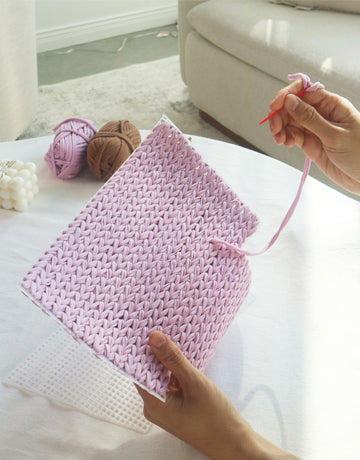

You've probably had that moment lately. You close your laptop, set your phone face down, and think, I want something calm to do with my hands.
Not a craft that needs a studio. Not a hobby that sends you shopping for fifteen separate tools. Just something warm, tactile, and satisfying enough to carry you through a quiet evening at the kitchen table.
That's where rug hooking kits in Canada make a lot of sense. They give you a gentle way into a traditional fibre craft without the usual guesswork. You get the materials together, the design already planned, and a project small enough that it feels inviting instead of overwhelming.
Your Cozy Crafting Journey Starts Here
Rug hooking has a lovely way of slowing a room down. You pull one loop, then another, and before long you're focused on colour, texture, and the small rhythm of your hands. It feels old-fashioned in the best way.

That feeling connects to a real Canadian story. Rug hooking has deep roots in Atlantic Canada, especially Newfoundland and Labrador, where it grew from a survival craft into a recognised heritage industry in the early twentieth century. During the Grenfell Mission era, 1892 to 1940, the craft became an important source of income for women in outport communities, as described in this history of rug hooking in Newfoundland.
Why it still feels relevant now
What I like most about rug hooking is that it doesn't ask you to be fast or perfect. It rewards steadiness. If you can hold a hook, follow a simple pattern, and sit comfortably with a cup of tea, you can learn it.
A lot of newcomers come in thinking rug hooking must be complicated because the finished pieces look so textured and rich. Then they realise the basic motion is simple. You pull loops of wool through a backing fabric, one at a time, building the surface slowly.
Rug hooking is one of those crafts that looks advanced from across the room and feels approachable once it's in your hands.
It also fits beautifully into the kind of home life many people are trying to create. If you've been leaning into soft lighting, handmade touches, and quieter routines, this Jackpot Candles guide to comfort pairs nicely with the same mood. Rug hooking belongs in that world of intentional evenings and screen-free corners.
Why kits are such a good starting point
For a first project, a kit removes the hardest part for beginners, which is figuring out what to buy. You're not standing in front of a supply wall wondering whether you need burlap or linen, what size hook makes sense, or how much wool to order.
Instead, you get a small project with a clear beginning and end. That matters. Early success builds confidence, and confidence is what turns “I tried it once” into “I think I've found my craft.”
What to Expect Inside Your First Rug Hooking Kit
A good beginner kit isn't just a bundle of supplies. It's a system. Every piece inside has a job, and when the kit is well put together, those pieces work together so you can focus on learning the motion instead of troubleshooting materials.
One Canadian beginner kit description lists a hand-drawn pattern on burlap, all necessary wool cloth strips, a rug hook, a colour key, a picture of the finished project, and instructions, with an estimated completion time of 2 to 4 hours on the Wool-Tyme kit page. That's exactly the kind of complete setup a newcomer should look for.

The parts that matter most
Here's what each item does for you.
-
Pattern on backing fabric
This is your roadmap. For beginners, a pattern already drawn on burlap keeps things straightforward. You don't need to transfer a design first, and you can start hooking right away. -
Wool strips or wool textures
Pre-selected wool saves you from one of the trickiest beginner tasks, which is choosing colours and cutting material consistently. When the wool is included, the design is more likely to work as intended. -
Rug hook
This tool is shaped to pull loops through the backing. It's simple, but it's specialised. If the hook is already included, that's one less separate purchase and one less chance of buying the wrong thing. -
Colour key and finished image
These help when the pattern lines start to feel abstract. A small area of soft green may not mean much until you see it's part of a hillside or leaf. -
Instructions
Beginners need more than a supply list. They need order. Good instructions tell you how to start, where to place the fabric, and how to keep your loops even.
What may or may not be included
Shoppers often get caught by inconsistent kit definitions. Some listings say “kit” but really mean “pattern plus wool.” Others include the hook but not the hoop or frame. That's why I always tell new crafters to read the product description line by line.
Questions worth checking before you buy:
- Does it include the hook or do you need to add one?
- Is the backing fabric pre-printed with the design?
- Are the wool strips included, or only the pattern?
- Does it mention a hoop or frame, or is that separate?
- Are instructions illustrated, or only written?
Practical rule: If a kit doesn't tell you exactly what's in the box, assume you may need extras.
Why backing and tension matter
Canadian kit listings and instructional materials commonly centre on burlap or linen backing, along with a hook and instructions. They also show that the backing should be held in a hoop or frame to keep the tension consistent. For small 6-inch beginner projects, an 8- to 12-inch hoop is a common setup because it gives you enough margin to keep the fabric stable while you work, as shown on The Knit Cafe Toronto rug hooking kit listings.
If the backing loosens while you hook, your loops can vary in height and the fabric can pucker. That's why tension isn't a fussy extra. It affects the final piece.
If you want a fuller look at the basic tools before shopping, this guide to rug hooking supplies is a handy companion.
How to Choose the Right Rug Hooking Kit
You are sitting at the kitchen table on a Saturday afternoon, tea nearby, ready to start. The easiest way to keep that feeling going is to choose a kit that fits a beginner's hands, time, and budget, not just one with the nicest product photo.
A first kit should feel like a good first baking recipe. You want something clear, forgiving, and likely to turn out well. If the design is too busy or the project is larger than you expected, the craft can feel harder than it really is.
Start with a size you can finish
For a first project, small is usually smarter.
A compact kit lets you learn the hook motion, get used to the backing, and see progress quickly. That matters more than crafters sometimes realize. Finishing one small piece teaches more than half-finishing a large one because you get to experience the whole process from first loop to final trim.
Many beginner kits sold in Canada are sized as small decorative projects rather than full floor rugs. That is often the sweet spot for a first try.
Here is the practical reason:
- Less fabric to handle means the work feels steadier in your hands.
- Fewer sections to fill makes it easier to stay oriented.
- Shorter project time helps you decide whether you enjoy the craft before spending more on larger kits or extra supplies.
If you are comparing two kits and one looks slightly plain while the other has tiny details everywhere, choose the plainer one first. A small floral, simple bird, house, heart, or bold geometric design usually gives a smoother start than a detailed scene from nature.
Look for shapes you can follow without squinting
Online photos can be misleading. A design may look charming from far away, then turn out to be full of narrow outlines and little colour changes.
Zoom in before you buy. If the pattern has clear sections that you can mentally trace with your finger, that is a good sign. If the design looks like a puzzle with lots of tight turns, save it for later.
Good beginner patterns usually include:
- Larger areas of colour
- Simple outlines
- Clear contrast between neighbouring sections
- Only a modest number of colour changes
That last point matters for Canadian shoppers because every extra add-on can affect total cost. If a kit is not complete and you need extra wool strips to finish a complicated design, the final bill can climb once shipping is added.
Choose the method first, then the motif
This is one of the easiest places to get confused.
A search for rug hooking kits in Canada often brings up punch needle kits too. They both create loops, so the finished photos can look like cousins. The tools and motions are different, though, and buying the wrong kind of kit is a frustrating way to start.
| Feature | Traditional Rug Hooking | Punch Needle |
|---|---|---|
| Main tool | Rug hook | Punch needle tool |
| Basic motion | Pull loops up through the backing | Push yarn through the fabric |
| Common materials | Wool strips on burlap or linen | Yarn or thread on suitable fabric |
| Typical beginner feel | Slower, more deliberate loop-by-loop work | Repeated punching motion |
| Best for | Traditional hooked texture and wool-strip projects | Decorative looped designs with yarn |
If the listing shows wool strips, burlap or linen, and a hook pulling loops up, you are looking at traditional rug hooking. If it shows a hollow needle tool and yarn being pushed into fabric, it is punch needle.
If you want to see the hand motion before ordering, this short guide on how traditional rug hooking works step by step can help you tell the difference.
Buy the craft you want to learn, then pick the design within that craft.
Read the listing like a Canadian shopper
This is the part many craft guides skip.
When you buy in Canada, the right kit is not only about pattern and colour. It is also about what the total order will really cost by the time it reaches your door. A low sticker price from another country can stop looking low once shipping, currency conversion, taxes, or courier fees appear at checkout.
So while you compare kits, check these details together:
- Where the shop ships from
- Whether prices are in Canadian or U.S. dollars
- Whether shipping is flat-rate or calculated at checkout
- Whether the kit already includes the beginner tools you need
- Whether the listing is clear enough that you can tell if extra supplies will be needed
A slightly higher-priced Canadian kit can still be the better value if it includes the hook, backing, wool, and instructions, and arrives without surprise costs.
A simple shopping checklist
Before you click checkout, look for these signs that a kit is beginner-friendly and fully complete:
-
The contents are spelled out clearly
You should be able to see exactly what is included, not guess from the photo. -
The finished project is small or modest in scale
Your first kit should feel manageable over a day or weekend of relaxed crafting. -
The pattern is visually simple
Clear shapes beat fussy detail when you are still learning the motion. -
The method is clearly named
The listing should say traditional rug hooking if that is what you want, not leave you sorting it out from pictures alone. -
The seller sets clear buying expectations
Canadian shoppers benefit from listings that explain shipping origin, timing, and what you may need to add separately.
A good first kit gives you fewer surprises. That is what builds confidence.
Your First Rug Hooking Project Step by Step
You sit down with your new kit, the wool is sorted, the pattern is in front of you, and for a moment the whole thing feels less like a cozy craft and more like learning to drive stick shift. That feeling passes quickly. Rug hooking has a simple rhythm, and once your hands catch it, the work becomes calm and satisfying.
The first goal is not perfection. It is getting comfortable with the motion and learning what a good loop feels like.

Set up your fabric properly
If your kit does not include a hoop or small frame, adding one usually makes a first project much easier. A taut backing helps you see the holes clearly and keeps your loops more even.
Place the backing in the hoop so it feels firm under your hand, like the top of a drum with a little give, not pulled so tight that the fabric strains. If the backing sags, the hook catches awkwardly. If it is overstretched, your hands fight the fabric instead of working with it.
Before you start hooking, smooth the wool strips or yarn so they feed easily from underneath. A small setup step saves a lot of fidgeting later.
Learn the basic loop motion
Hold the wool underneath the backing. From the top, put the hook through a hole, catch the wool, and pull up a small loop.
That is the whole action.
What confuses beginners is height. You do not need tall loops to make progress. You want loops that are similar to one another and enough space between them that the backing does not buckle. If your row starts to look crowded or the surface feels lumpy, leave a little more room and relax your pull. Dense hooking can make a small piece curl.
Your non-hooking hand matters too. Let it guide the wool from underneath instead of tugging hard. Gentle feeding gives you better control.
Follow this beginner sequence
-
Outline one clear shape first
Pick something easy to see, such as a leaf, roofline, flower petal, or simple border. An outline gives your eye a boundary to follow. -
Fill that shape with steady rows
Work inward row by row. They do not have to look ruler-straight. They just need a steady pace and similar spacing. -
Pause and feel the surface
Run your fingertips across the hooked area every so often. Your fingers will notice uneven spots before your eyes do. -
Change colours at the edge of a shape
Finish one area, then switch colours. It keeps the design cleaner and helps you stay oriented on the pattern. -
Turn the hoop for comfort
Move the piece whenever your wrist feels cramped. Good posture and a comfortable angle matter more than sticking to one position.
A small beginner kit is helpful here because you can see progress early. That early progress builds confidence fast, which is one reason a complete starter kit is such a good buy for Canadian beginners. You can begin right away instead of pausing to order one missing tool.
Here's a visual walkthrough if you prefer learning by watching after you've read the basics:
Mistakes beginners often worry about
Nearly every new rug hooker worries they are doing it wrong. Usually they are just seeing normal first-project variation.
A few things to keep in mind:
-
Uneven early loops are normal
Your hands are learning a new motion, just like learning to knit without staring at every stitch. -
You can pull out loops and redo them
Rug hooking is forgiving, which makes it a kind first craft. -
Spacing matters more than speed
A slower, steadier pace gives you a flatter, neater result. -
The second half often looks better than the first
That does not mean the first half failed. It means you are learning as you go.
If you ordered your kit the way some people order monthly box subscriptions Canada, as a treat to enjoy a little at a time, that mindset helps here. A first project goes better when you let it be practice as well as progress.
If you want a more detailed beginner walkthrough after your first practice session, this rug hooking how-to guide is a useful next read.
Buying Rug Hooking Kits in Canada The Smart Way
This is the part many craft guides skip. Canadians don't just need to know which kit looks nice. They need to know what the order will cost by the time it reaches the door.
A U.S. listing can look attractive at first glance, especially if the kit price alone seems lower. But the listed price isn't always the final price.
Think in landed cost, not sticker price
For Canadian buyers, the total cost of a kit can change a lot depending on where it ships from. Imported orders may be assessed GST/HST and can also involve duty and brokerage depending on the item and country of origin, while many domestic retailers offer flat-rate shipping or free shipping over a threshold, which often makes the purchase more predictable, as noted on the Ottawa rug hooking suppliers page.
That predictability matters. Beginners usually want one clean purchase, not a surprise notice from the carrier.
A cheaper kit price can become the more expensive order once shipping, taxes, and import handling are added.
What to compare before you order
Use this quick buying lens when you shop:
-
Shipping origin
Check whether the seller is in Canada or shipping across the border. -
What's included
A lower price may reflect a partial kit. If you still need a hook or hoop, the savings disappear quickly. -
Delivery clarity
Look for clear wording on processing time, shipment timing, and return policy. -
Provincial taxes
Your total changes depending on your province because GST/HST rates vary across Canada.
When a Canadian shop often makes more sense
Domestic shopping usually works best when you want certainty. You're less likely to deal with brokerage surprises, and many Canadian craft retailers understand that beginners need fuller descriptions, not just a product photo.
That same practical mindset shows up in other Canadian subscription and specialty hobby shopping too. If you like comparing not just products but the full experience, including delivery and value, this look at monthly box subscriptions Canada is a useful example of how Canadian shoppers often evaluate convenience alongside cost.
For readers exploring more beginner-friendly project options beyond fibre, this roundup of adult craft kits in Canada can help you compare hobbies with the same all-in-one appeal.
Finishing Your Project and Finding Your Next Craft
When your hooking is complete, take a minute to enjoy it before you fuss with finishing. First projects deserve a little admiration.
To tidy the piece, remove it from the hoop or frame and let it rest flat. If the backing looks slightly rumpled, gentle finishing helps. Many crafters lightly steam the piece from the back or lay it flat to settle the shape before dealing with the edges. Keep the pressure gentle so you don't crush the loops.
Simple ways to finish neatly
A beginner piece often ends up as framed textile art, a tabletop accent, or a small decorative mat. Your finishing choice depends on how you want to use it.
Some easy options:
- Turn and hem the edges for a simple handmade finish.
- Mount it for display if you like the idea of textile wall art.
- Use it as a small decorative piece on a side table or shelf.
Skills you'll carry into other crafts
Rug hooking teaches more than one technique. It teaches patience, material awareness, colour confidence, and how to trust a process that builds slowly. Those are useful skills in almost any hands-on hobby.
If you discover that what you really loved was working from a complete kit, following clear instructions, and ending up with something polished, that opens the door to plenty of other beginner-friendly crafts too.
If you're ready for your next creative project, Stitch Mingle is a lovely place to browse. Their beginner-friendly DIY kits include polished leather craft bag and keychain projects, plastic canvas kits, embroidered patches, and personalised name tags, all designed to be approachable and satisfying to finish. If you enjoy crafts that arrive with the essentials already sorted and instructions that don't leave you guessing, it's an easy next stop after your first rug hooking win.