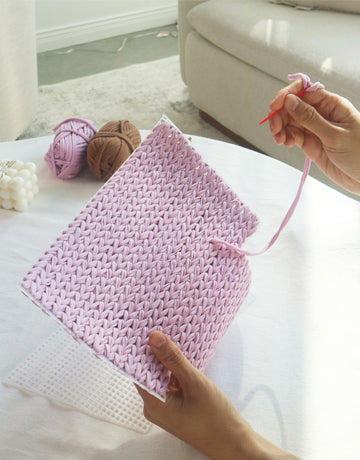

A starter knitting kit is the ideal entry point for anyone looking to learn the craft. It bundles all the essential tools, high-quality materials, and clear instructions needed to complete your first project successfully. This guide will walk you through what to look for in a kit, how to master your first stitches, and troubleshoot common beginner mistakes, ensuring a smooth and enjoyable start to your knitting journey.
Think of this guide as your friendly companion, here to get you feeling excited and totally ready to start knitting.

Understanding the Value of a Starter Knitting Kit
Welcome to the wonderfully cozy world of knitting! If you've ever found yourself admiring a handmade scarf and thinking, 'I wish I could make that,' then you're absolutely in the right place. A starter kit bundles all the essentials together, so you can skip the overwhelming trip to the craft store and get straight to making.
Inside a typical kit, you'll find the two most important things: knitting needles and yarn. We’ll get into the specifics of those a little later. For now, just know that the goal is to give you a smooth, stress-free start. We'll walk through everything from choosing your perfect kit to learning your first stitches and even how to fix those little mistakes everyone makes.
Why Is Knitting So Popular?
Knitting has made a huge comeback, and for good reason. It’s a wonderful screen-free way to unwind and let your creativity flow. The rhythmic click-clack of the needles is incredibly meditative, helping to quiet a busy mind and improve focus. Plus, there’s nothing quite like the feeling of watching a simple ball of yarn turn into something you can actually wear or use.
This isn’t just a feeling, either—the numbers back it up. The global knitting yarn retail market was valued at USD 6.21 billion in 2024 and is expected to grow to an incredible USD 11.1 billion by 2035. Much of this growth comes from younger generations, with data showing about 40% of individuals aged 18-34 have tried knitting or similar crafts.
Key Features of a High-Quality Kit
A truly great starter kit does more than just give you supplies; it sets you up for success from the very beginning. It should feel like a complete learning experience in a box.
Think of a quality kit as your personal knitting tutor in a box. It should not only give you the tools but also the confidence to use them, ensuring your first project is a success, not a struggle.
Here’s what you should look for:
- Clear, step-by-step instructions that are simple and easy to follow.
- High-quality materials that are beginner-friendly, like smooth wooden needles and soft, chunky yarn that’s easy to handle.
- Access to video tutorials for visual learners, which is a standard feature in all Stitch Mingle kits.
Our goal is to demystify the entire process, making you feel totally empowered to pick up your needles and start your creative journey today.
What's Inside a Starter Knitting Kit?
Cracking open your first starter knitting kit is a genuinely exciting moment. It feels a bit like opening a box of magic—everything you need to turn a simple strand of yarn into something cozy and wonderful. But what exactly should be in there? A good kit removes all the guesswork, bundling the essential tools and materials so you can dive right in.

Think of your needles as the architect's pen and the yarn as the building material. They're the stars of the show, for sure. Everything else in the kit is your trusty support crew, there to make the entire building process go off without a hitch.
Core Components: Needles and Yarn
Let's start with the two absolute must-haves: the needles and the yarn. The right pair can make all the difference when you're just starting out, and a well-designed kit knows this.
Most beginner kits will come with straight needles made from wood or bamboo, and for good reason. These materials have a slight, natural grip that helps stop your stitches from slipping away—a super common frustration when you're still getting the hang of things. Shiny metal needles might look sleek, but they can be a bit too slippery for a first-timer.
You'll likely find needles in a medium size, somewhere between 6mm to 8mm in diameter. This is the sweet spot. They’re chunky enough for you to clearly see what you’re doing but not so massive that they feel awkward in your hands.
The yarn choice is just as important. Kits usually include a worsted or chunky weight yarn. This thicker fibre is much easier to work with, and it has the added bonus of making your project grow really quickly. There's nothing more motivating than seeing your creation take shape fast! Look for smooth, light-coloured acrylics or wool blends, as they won’t split apart easily and make it simple to see each individual stitch.
A well-chosen starter knitting kit is designed for a positive first experience. It prioritizes ease-of-use with tools like smooth wooden needles and chunky yarn, so your focus stays on learning the craft, not fighting your materials.
Essential Accessories: Knitting Notions
Now, beyond the needles and yarn, your kit will have a few small but incredibly mighty tools. We call them notions in the knitting world, and they are the unsung heroes that manage all the little details.
- Tapestry Needle: This isn't a sewing needle! It’s a large needle with a blunt tip and large eye, designed for weaving in all those loose yarn ends when you're done. It gives your project a clean, professional finish.
- Stitch Markers: Think of these as little bookmarks for your knitting. They're small rings or clips you slide onto your needle to mark an important spot, like the beginning of a row or a pattern change.
- Measuring Tape: A flexible tape measure is your best friend for making sure your project is the right size. It helps you check your progress against the pattern's dimensions.
- Small Scissors or Yarn Snips: You'll need a clean cut. A dedicated pair of small, sharp scissors for snipping your yarn is a total must-have.
These little helpers are what turn a potentially chaotic process into an organized, relaxing, and enjoyable one.
Essential Components Of A Starter Knitting Kit
This table breaks down the key tools and materials you'll find in a great beginner's kit, explaining their role and why they’re chosen specifically for new knitters.
| Component | Technical Term/Metric | Function for Beginners |
|---|---|---|
| Knitting Needles | 6mm–8mm straight needles | Smooth wooden or bamboo needles offer good grip, preventing stitches from slipping off while you learn. |
| Yarn | Worsted or chunky weight | Thicker yarn is easy to see and handle, helping projects grow faster and keeping you motivated. |
| Tapestry Needle | Darning needle | Weaves in loose yarn tails to give your project a polished finish. The blunt tip slides through yarn without splitting it. |
| Stitch Markers | Ring or locking markers | Act as placeholders to mark specific points in your knitting, helping you keep track of your pattern. |
Having these essentials bundled together means you have a complete, well-thought-out system right from the start, setting you up for a fantastic first project.
How to Choose the Right Kit for Your First Project
So, you're ready to pick up some needles, but with so many kits out there, where do you even begin? Think of it this way: not all starter knitting kits are the same, and the right one for you really comes down to one thing—what you're excited to make first. This is your personal guide to matching a kit with your dream project, making sure your first time knitting is all fun and no frustration.
Picking your first project is a lot like learning to cook. You wouldn't try to whip up a five-course gourmet meal on your first day in the kitchen, right? You’d start with something simple and satisfying, like scrambled eggs, to get the hang of the basics. Knitting is exactly the same. You want to start with a project that gives you a quick, confidence-boosting win.
Match the Kit to the Project
The best starter kits are designed around a single, totally achievable project. This approach is brilliant because it means you get the perfect amount of yarn and the right tools—no guesswork, no waste, and no confusion. As you look around, keep an eye out for kits that are clearly labelled for projects like washcloths, scarves, or simple beanies.
Here’s a quick look at some classic beginner projects and the skills you’ll pick up along the way:
- Simple Washcloths or Dishcloths: These small squares are the perfect training ground for the two most important stitches in knitting. You’ll get comfortable with the knit stitch and the purl stitch, and you'll see how they work together to create fabrics like garter stitch (all knit stitches) or stockinette (rows of knit alternating with rows of purl).
- Cozy Garter Stitch Scarves: A scarf is a fantastic first "wearable." It's a great way to practice your knit stitch over a longer piece, which teaches you how to keep your tension even and consistent. Plus, you’ll learn how to cast off to create a clean, finished edge.
- Beginner Beanies or Headbands: These projects are your introduction to knitting in the round, which is usually done on circular needles. It sounds tricky, but it’s a fun way to create seamless tubes of fabric. You’ll learn how to join your work and use simple decreases to shape the crown of the hat.
What To Look For In Kit Descriptions
Once you have a project in mind, it's time to look a little closer at what the kit actually offers. A truly great starter knitting kit is more than just a box of supplies; it's a full support system designed to help you succeed.
The best kits don't just sell you yarn and needles; they sell you a successful first experience. Look for clear instructions and video support, as these are the elements that transform a box of supplies into a guided lesson.
Pay special attention to the learning materials included. Clear, step-by-step written instructions with helpful diagrams are non-negotiable. Even better are kits that give you access to video tutorials, which is a key feature in all Stitch Mingle kits. Honestly, being able to watch someone show you how to do a stitch is a game-changer. It can clear up confusion in seconds and set you up for that amazing feeling of accomplishment.

It really highlights how matching your kit to your goals and skills sets you up for success before you even cast on.
How-To: Your First Stitches with a Starter Kit
Alright, you've got your starter knitting kit unpacked and everything is laid out. Now for the really exciting part! This is where you get to turn a simple ball of yarn into your very first piece of knitted fabric. This section provides step-by-step instructions for the three fundamental techniques every new knitter must learn.
Step 1: Create a Slip Knot and Cast On
Every knitting project begins by getting the yarn onto your needle. This happens in two parts: the slip knot and the cast-on.
- Make the Slip Knot: Create a loop with your yarn, leaving a tail of about 6 inches. Cross the tail end over the working end (the part connected to the ball) to form a pretzel shape. Reach through the loop, grab the working yarn, and pull it through to create a new, adjustable loop. Place this loop on one needle and gently pull both yarn ends to tighten it. This is your first stitch.
- Cast On Your First Row: There are many cast-on methods, but a common beginner technique is the "thumb method." Hold the needle with the slip knot in your right hand. Make a loop around your left thumb with the working yarn. Insert the tip of the right needle into this thumb loop, wrap the yarn around the needle, and pull it through. You now have a second stitch on your right needle. Repeat until you have the required number of stitches.
Step 2: Master the Knit Stitch
Once your stitches are cast on, you're ready for the main event: the knit stitch (k). This is the absolute cornerstone of knitting.
The knit stitch is the fundamental building block of knitting. Once you learn its simple 'in, around, through, and off' motion, you've unlocked the ability to create countless projects, from scarves to blankets.
Follow these four movements to create a single knit stitch:
- Insert: Hold the needle with the cast-on stitches in your left hand. Gently slide the tip of your right-hand needle into the front of the first stitch on your left-hand needle, from left to right.
- Wrap: Take the working yarn and wrap it counter-clockwise around the tip of the right-hand needle.
- Pull Through: Carefully guide the right needle, bringing the wrapped loop of yarn back through the stitch on your left needle.
- Slide Off: Let the original stitch slip right off the end of your left-hand needle. You've just transferred a new stitch to your right needle!
Repeat this process for every stitch in the row. Once the row is complete, swap the needles so the full one is back in your left hand, and start again.
Step 3: Learn How to Cast Off
When your project is the desired length, you need to "cast off" (also called "binding off") to secure the stitches and prevent them from unraveling.
- Knit the first two stitches of the row as normal.
- Lift the first stitch over the second: Using the tip of your left needle, lift the first stitch on your right needle up and over the second stitch, and let it drop off the needle. You have now cast off one stitch and have one stitch remaining on your right needle.
- Knit one more stitch: You should now have two stitches on your right needle again.
- Repeat the process: Continue knitting one stitch and then lifting the previous one over it until only one loop remains. Cut the yarn, leaving a 6-inch tail. Pull the tail through the final loop to secure it.
Troubleshooting Common Beginner Mistakes
Let’s be honest: every knitter, no matter how experienced, makes mistakes. It’s just part of the process! Think of this as your friendly guide to navigating those first few hiccups without the urge to throw your project across the room. We’ve all been there, and trust me, every mistake is a lesson in disguise.

So, let's walk through a couple of the most common bumps in the road for new knitters. We’ll look at how to spot them, how to fix them, and most importantly, how to stay calm and carry on knitting.
The Runaway Dropped Stitch
You’re knitting along, feeling great, and then you see it—a lonely loop that has escaped your needle, leaving a tiny "ladder" of yarn in its wake. Don't panic! This is just a dropped stitch, and it's much easier to fix than it looks.
Your best friend here is a small crochet hook, which is often included in a good starter knitting kit, but the tip of your other needle works in a pinch. Think of it like using a ladder to climb back up. Just slide your hook into the runaway loop from front to back, grab the bottom-most rung of yarn, and pull it right through the loop. Keep doing this for each rung until you’re back at the top, then pop the rescued stitch back onto its needle. Easy!
Managing Your Tension
Is your knitting so tight that your hands are starting to ache? Or is it so loose and gappy that it looks more like a net? Both of these common frustrations come down to tension, which is simply how tightly you hold the yarn as you work.
Consistent tension is the secret to beautiful, even fabric. It’s a skill that develops with practice, not perfection on day one. Be patient with your hands as they learn this new rhythm.
Finding your flow takes a little time, but here are a few tips to get you there faster:
- Too Tight: If it’s a struggle to get your needle into a stitch, your hands are probably cramping. Try to consciously relax your grip on everything—the needles, the yarn, your shoulders. Take a deep breath!
- Too Loose: If your stitches look a bit sloppy and uneven, you need a little more control. Try wrapping the yarn around your fingers in a different way to create more resistance.
Remember to take breaks. Knitting for hours on end can make your hands tired, and tired hands lead to wonky tension. Seeing these little challenges as a normal part of learning will help you feel more confident. No little slip-up is going to stop you now.
A Few Common Questions About Knitting Kits
It's totally normal to have a bunch of questions when you're about to jump into a new hobby. Honestly, we get asked these all the time! So, let's clear up some of the common worries people have about starting with a starter knitting kit.
We want you to feel excited and confident, not confused. Let's get those questions answered so you can get right to the fun part—making something beautiful with your own two hands.
Can I Really Learn To Knit From A Kit?
You absolutely can! This is probably the biggest question we hear. A lot of people worry that knitting is too complex to learn on their own, but a well-designed starter kit is made to prove that idea wrong.
Think of modern kits as a complete learning experience, not just a box of supplies. They're designed to break everything down into small, simple steps. It feels less like a tough class and more like a guided project you can actually enjoy.
A great starter knitting kit is like having a patient teacher in a box. It's designed specifically to build your confidence from the ground up, ensuring your first project is a success.
With clear instructions and video guides to follow along, you'll be surprised how quickly you can master the basics, like the simple knit and purl stitches.
What Project Should I Start With?
The best first project is always something small and satisfying. A simple dishcloth or a chunky scarf made with just the garter stitch are fantastic choices. Why? Because they let you practice the fundamental knit stitch over and over again.
That repetition is key—it's how you build muscle memory and learn to keep your tension even. Most kits focus on these kinds of projects for a reason: they give you a quick win! Finishing that first piece, no matter how simple, is a massive confidence boost that makes you eager to tackle what's next.
How Long Does It Take To Learn?
The honest truth? There's no magic number, because knitting is a skill that grows every time you practice. That said, you can easily learn the basic knit stitch in less than an hour! Many beginners finish their first small project, like a washcloth, in a single weekend.
The most important thing is to be patient with yourself and try to enjoy the process. With every row you complete, the rhythmic motion becomes more natural and automatic. Before you know it, you’ll be able to relax and just enjoy the craft.
What If The Included Yarn Isn’t A Natural Fibre?
While gorgeous fibres like merino wool or alpaca are a dream to work with, they aren't always the best choice for your very first project. Many starter kits come with high-quality acrylic or cotton-blend yarns, and there are some really good reasons for that:
- Durability: These fibres are tough! They can handle being unravelled and re-knit multiple times as you learn and fix mistakes (which everyone does!).
- Clarity: They usually have a smooth, clean texture that makes it much easier to see your individual stitches. This is a huge help when you're just starting out.
- Easy Care: Most acrylic and cotton yarns are machine washable, which is perfect for practical items you’ll actually use, like dishcloths and scarves.
Knitting is a truly global craft, and the materials reflect that. In 2023, the worldwide knitting industry employed an incredible 12.5 million workers, many of whom are involved in producing these versatile, beginner-friendly yarns that connect hobbyists everywhere.
Ready to find the perfect project to kick-start your crafting journey? At Stitch Mingle, we put together beautiful, beginner-friendly kits that include everything you need to create something amazing.
Explore Our Full Collection of DIY Kits at Stitch Mingle Today!
Explore More from Stitch Mingle
- Looking for other creative hobbies? Check out our guide on easy crafts to do at home.
- Curious about crochet? Find the perfect crochet kit for your next creative adventure.
- Love working with thread and fabric? Discover our sewing kits for beginners.