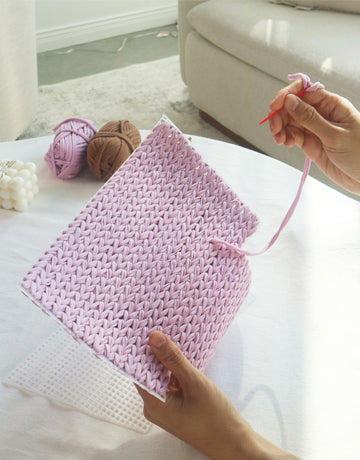

Getting started with knitting can feel like a whole new world, and a knitting for beginners kit is your perfect entry point. This guide provides a comprehensive overview of what to expect in a beginner's kit, how to choose the right one for your goals, and step-by-step instructions for completing your first project. With a well-designed kit, you can skip the confusion of a craft store and dive straight into the rewarding process of creating something by hand.
H2: Your Creative Journey Starts With The Right Kit

Walking into a craft store for the first time can be a little intimidating. There are walls of yarn in every colour and texture, and so many different types of needles. Which ones are right? What yarn won't be a nightmare to work with? How do you even make sense of a pattern?
A good beginner's kit answers all of those questions for you.
Think of it like getting one of those meal-prep boxes. Instead of wandering the grocery store trying to find unfamiliar ingredients, you get a box with everything pre-measured and ready to go. A knitting kit does the same thing for your creativity, letting you skip the confusing setup and get right to the best part: making something cool.
H3: What Makes a Kit the Best Starting Point
The biggest advantage of starting with a kit is confidence. When you know you have the right gear, you can relax and focus on learning the actual movements—how to hold the needles, how to cast on, and how to form that very first knit stitch. It’s a guided path that helps you build momentum and keeps you from getting frustrated.
Everything inside is hand-picked for new knitters:
- Easy-to-handle needles, usually made of wood or bamboo because they have a bit more grip than metal ones.
- Smooth, light-coloured yarn so you can actually see what your hands are doing and spot your stitches clearly.
- A simple, achievable project like a scarf or a dishcloth, which gives you a quick win and something to be proud of.
A curated kit from Stitch Mingle lets you dive straight into creating, with all the essential tools and easy-to-follow guidance at your fingertips. You get to discover the deep satisfaction of making something amazing with your own two hands.
In the end, it’s not just about the yarn and needles. It’s about setting you up for a positive first experience with a wonderful craft. By removing the initial hurdles, a great kit ensures you start your knitting journey with a sense of accomplishment, not confusion.
H2: What's Inside a Knitting for Beginners Kit: Tools and Materials

Cracking open your first knitting for beginners kit is a special moment. It's like a perfectly prepped recipe box for your first creative project, where every single piece has been picked out to help you succeed. Let's take a look at the specific tools and materials inside.
H3: The Essential Tools of the Craft
First up, you’ll find a pair of knitting needles. They’ve been chosen specifically with new hands in mind.
- Material: Most beginner needles are made of bamboo or wood. Unlike slippery metal needles, these have a natural grip that helps prevent stitches from sliding off.
- Size: They’re usually chunky, somewhere between 8mm and 10mm in diameter. This size is easier for beginners to hold and creates large, clear stitches you can easily see.
Of course, you can't knit without yarn! The yarn included in a beginner kit is just as thoughtfully chosen. It's typically a worsted or bulky weight yarn, meaning it’s thick and satisfying to work with. The fibres are smooth—often a soft acrylic or wool blend—which stops the strands from splitting apart as you knit, a common frustration for newcomers.
Think of your knitting kit as a creative GPS. The pattern is your destination, the needles are your vehicle, and the stitch markers are the waypoints that keep you from getting lost.
This all-in-one approach is exactly why kits have become so popular. The hand knitting yarn market is projected to grow at a CAGR of 3.8% globally. When an incredible 52 million Americans picked up knitting during the pandemic, brands like Stitch Mingle were ready with kits that made it easy to start. You can read more about these fascinating knitting industry statistics and how they're shaping the craft.
H3: Accessory Tools for a Professional Finish
Beyond the yarn and needles, your kit will have a few small but incredibly useful accessories.
| Tool | Purpose |
|---|---|
| Darning/Tapestry Needle | A large, blunt-tipped needle used to weave in loose yarn ends for a clean, professional finish. |
| Stitch Markers | Small plastic or metal rings that slide onto your needles to mark important spots, such as the beginning of a row or a pattern repeat, saving you from constant counting. |
| Simple Pattern | A printed guide with clear, step-by-step instructions for a beginner-friendly project like a scarf or dishcloth. |
Every single piece in a knitting for beginners kit is there for a reason: to make your first dive into knitting a fun and rewarding one.
H2: How to Choose the Perfect Beginner Knitting Kit

The best kit is the one with a project you're actually excited about. That excitement is what will carry you through those first few clumsy stitches until it all clicks. Think of it as your road map: pick a destination (your project), and it'll show you the right vehicle (needles) and fuel (yarn) to get you there smoothly.
H3: Align Your Kit with Your First Project Goal
The project included in your kit is more than just a pattern; it’s your first teacher.
- A Scarf: The classic first project. It’s a long rectangle that involves repeating the simple knit stitch over and over, perfect for building muscle memory.
- A Dishcloth: This is all about the quick win. It’s a small, practical project you can finish in an evening.
- A Simple Hat: A brilliant first step into making wearables. It introduces knitting in the round, a skill that opens up a whole new world of projects.
H3: Technical Specifications: What to Look for in Needles and Yarn
Any good knitting for beginners kit will have already paired the right needles and yarn for you, but it’s helpful to understand why they were chosen.
- Needle Material: Look for bamboo or wood. Their surface has just a tiny bit of grip, which helps keep your stitches from sliding off too easily.
- Yarn Texture: Opt for smooth yarn, like a soft merino wool or an acrylic blend. It lets you see every stitch clearly.
- Yarn Color: A light-colored yarn makes it much easier to see your stitches and spot any mistakes.
- Yarn Weight: Most starter kits come with worsted or bulky weight yarn (a Craft Yarn Council weight of 4 or 5). This chunkier yarn is easier to hold and knits up quickly, which is incredibly motivating.
At the end of the day, picking a kit is less about the technical specs and more about finding something that makes you happy. If you're genuinely excited to create the project, you're pretty much guaranteed to finish it.
H3: Comparison of First Knitting Project Options
Use this table to decide which beginner kit project best matches your learning style and creative goals.
| Project Type | Skills Learned | Typical Time to Complete | Best For |
|---|---|---|---|
| Simple Scarf | Casting on, knit stitch, binding off, consistent tension | 5-8 hours | Knitters who want to master the core stitch through repetition and create a wearable accessory. |
| Dishcloth | Casting on, knit stitch, binding off, creating a square shape | 1-2 hours | Those seeking a quick, practical project with a low time commitment and a tangible result. |
| Beanie/Hat | Knitting in the round, decreasing stitches, casting on, binding off | 4-6 hours | Ambitious beginners who want to create their first wearable garment and learn a new technique. |
By thinking through what you want to make and what tools you’ll need, you can pick a knitting for beginners kit that feels like it was put together just for you.
H2: How-To: Your First Project Step-by-Step

You've got your knitting for beginners kit, and you're ready to transform that squishy ball of yarn into something real. We're going to walk through the foundational techniques together, one step at a time.
H3: Step 1: Making the Slip Knot
Every knitting project begins with a slip knot. It's the very first loop you'll put on your needle.
- Make a loop with your yarn, leaving a tail about six inches long.
- Drape the working yarn (the part still attached to the ball) across the back of the loop.
- Reach through the loop, grab the working yarn, and pull it through to create a new loop.
- Place this new loop onto one needle and gently pull both yarn ends to tighten it until it's snug but can still slide.
H3: Step 2: Casting On Your First Stitches
Casting on is the process of creating your first row of stitches. Your kit's instructions will tell you exactly how many stitches to cast on. The "long-tail cast-on" is a fantastic, sturdy method for newcomers. It can feel like a bit of a finger-twister at first, but watching a quick video tutorial usually makes it all click into place.
Knitting is a skill built on a few simple, repeated motions. Once you master the slip knot, the cast on, and the knit stitch, you have everything you need to create an amazing number of projects.
You're joining a huge community of makers. The global yarn market was valued at $6.5 billion in 2020, and the U.S. market alone hit $1.8 billion by 2022. For new crafters, this boom means incredible access to materials, with sales of chunky yarn jumping by 40% in 2022. You can dig into more knitting industry trends to see just how popular this hobby has become.
H3: Step 3: Working the Knit Stitch
The knit stitch is the absolute cornerstone of knitting. When you work just the knit stitch on every row, you create a beautiful, squishy texture called "garter stitch" that lies perfectly flat—no curling edges here! Learning the knit stitch is like learning a simple dance for your fingers. Once you find your rhythm, you'll be doing it without even thinking.
H3: Step 4: Binding Off to Finish
When your project is the desired length, you need to bind off (also called casting off). This process secures all the live stitches so your hard work doesn't unravel. It involves knitting two stitches, then lifting the first stitch up and over the second one and off the needle. You repeat this all the way across the row until only one loop remains. Cut the yarn, pull the tail through that final loop, and tighten. You did it!
H2: Fixing Those First Few Knitting Mistakes
The most important thing to remember is that almost every knitting mistake is fixable. Think of these hiccups not as failures, but as your first real lesson in how knitting actually works. Your knitting for beginners kit is the perfect place to make these mistakes and learn how to fix them without any pressure.
H3: How to Rescue a Dropped Stitch
Seeing a live loop that has fallen off your needle is probably the number one scare for any new knitter. It creates a little "run" or "ladder" in your work. The good news? It’s a surprisingly easy fix with a crochet hook.
- Secure the dropped stitch with your fingers so it doesn’t unravel any further.
- Slide a crochet hook into the dropped loop from front to back.
- Hook the horizontal strand of yarn (the "ladder rung") directly above the loop.
- Pull that strand through the loop on your hook. You've just "knitted" it back up one row!
- Repeat this for each ladder rung until you reach the top.
- Slip the final loop back onto your left-hand needle, making sure it isn't twisted.
Every mistake is just a learning opportunity in disguise. Honestly, learning how to fix a dropped stitch is one of the most empowering moments for a new knitter. It replaces that feeling of frustration with pure confidence.
H3: Troubleshooting Common Issues: Tension, Holes, and Stitch Count
- Uneven Tension: If some stitches are tight and others are loose, don't worry. This is normal. Consistent tension comes from practice as your hands develop muscle memory. Focus on a comfortable, relaxed grip on your yarn.
- Accidental Holes: These are usually caused by an unintentional "yarn over," where the yarn wraps over the needle. On the next row, you can often just let this extra loop drop off the needle to fix it.
- Extra or Missing Stitches: This happens when you accidentally knit into the space between stitches (an increase) or knit two stitches together (a decrease). If you have an extra stitch, simply "knit two together" (k2tog). If you're missing one, use a "make one" (M1) increase to get back on track.
Your first project is all about learning, not about creating a flawless masterpiece!
H2: What to Knit Next After Your First Kit
Congratulations! You’ve officially finished your first knitting project. Now that you've got the basic knit stitch down, you’ve unlocked a whole new world of creativity.
H3: Learning New Stitches and Techniques
Your first project was all about the knit stitch. The very next thing to learn is its counterpart: the purl stitch. Once you can knit and purl, you can create all sorts of different fabric textures.
- Stockinette Stitch: This is the classic, smooth 'V' pattern you see on most sweaters. You create it by knitting one row and purling the next row.
- Ribbing: By alternating knit and purl stitches in the same row (e.g., knit 1, purl 1), you create a stretchy fabric perfect for cuffs and hat brims.
- Knitting in the Round: Using circular needles, this technique lets you knit seamless tubes for projects like beanies and cowls.
You've just joined a hobby that is both deeply personal and incredibly social. Every new stitch connects you to a massive, welcoming community of fellow makers.
This sense of community is stronger than ever. During the pandemic, knitting saw a massive resurgence, with an incredible 52 million people in the US picking up needles. For anyone starting with a Stitch Mingle kit, this means you’re joining a truly passionate group. Check out more on the growth of textile crafts in California.
H3: Dive into the World of Yarn and Community
Now that you've got one project under your belt, you can start having fun with different yarns and needles. Go ahead and explore softer fibres like merino wool or fall in love with a vibrant, hand-dyed skein. Connect with other crafters on Stitch Mingle’s social channels or find a local knitting group. Sharing your progress and seeing what others are making is one of the best ways to stay inspired.
H2: Frequently Asked Questions (FAQ)
It's totally normal to have a few questions before you dive into your first knitting kit. Let's clear them up so you can start with total confidence.
H3: What's the easiest yarn for a beginner?
For your first project, you’ll want a smooth, light-coloured, medium-weight (worsted) yarn. Wool or acrylic blends are fantastic choices because they have a bit of natural stretch, which is very forgiving. The most important thing is that you can clearly see your stitches—something that gets tricky with fuzzy or dark yarns.
H3: Are wooden or metal needles better for starting out?
Wooden or bamboo needles are highly recommended for beginners. They have a slightly grippy texture that helps stop stitches from accidentally slipping off the needle while you're still figuring out your tension and hand movements.
H3: Can I actually make a gift with my first project?
Absolutely! A simple, beautifully made scarf or a set of dishcloths from a beginner kit makes a wonderfully thoughtful and personal gift. The real charm is in its handmade quality, and it's a fantastic way to share your new skill with someone you care about.
Ready to start your own knitting adventure? Stitch Mingle has put together the perfect kits with everything you need right in one box. Unleash your creativity and find your first project at Stitch Mingle today!
Explore More from Stitch Mingle: