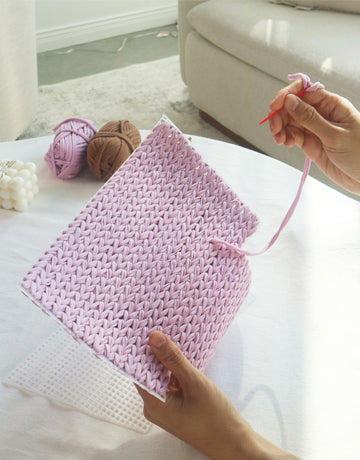

A knitting kit for beginners is your all-in-one start to a wonderful new hobby, bundling perfectly matched yarn, needles, and instructions into one package. It eliminates the guesswork of starting from scratch, allowing you to bypass overwhelming craft store aisles and dive straight into creating. This guide will walk you through what to look for in a kit, how to use it, and how to fix common first-timer mistakes, ensuring a successful and enjoyable first project.
H2: Why a Knitting Kit for Beginners is Your Best First Step
Walking into a craft store for the first time is both exciting and, let's be honest, a little intimidating. The sheer number of yarn types, needle sizes, and project books can make your head spin. A knitting kit for beginners cuts through all that confusion.
Think of it as a shortcut to the fun part. Instead of getting bogged down in research and worrying if you’ve bought the right things, a kit hands you everything you need. The yarn and needles are chosen to work together, which is a huge help in avoiding those early frustrations that can trip up new knitters.
H3: Save Time and Start with Confidence
The best part about a kit is that all the heavy lifting is done for you. Experts have already figured out the best materials for the project, so you don't have to guess. This means no wasted time, no buying the wrong yarn, and no mismatched needles.
You're not alone in wanting an easier start! Beginner craft kits are more popular than ever. In fact, they accounted for a whopping 42% of all handicraft sales in Canada last year. It just goes to show that people want to dive into a new hobby with a guaranteed win.
H3: Kit vs Separate Supplies: A Technical Comparison
Let's look at why a knitting kit for beginners is the simplest way to start your first project with confidence.
| Feature | Knitting Kit for Beginners | Buying Supplies Individually |
|---|---|---|
| Convenience | All-in-one, so you can start the moment you open the box. | Requires trips to the store or multiple online orders. |
| Cost-Effectiveness | Bundled pricing is often more affordable than buying each item separately. | Easy to overbuy or purchase incompatible materials by mistake. |
| Material Matching | Yarn (e.g., worsted weight) and needles (e.g., 8 mm) are perfectly paired for the project. | Risk of yarn splitting (from wrong needle type) or incorrect gauge (from wrong needle size). |
| Beginner Friendliness | Instructions are created specifically for your project and materials. | You’ll have to find and follow a separate pattern, hoping it matches your supplies. |
Ultimately, a knitting kit is all about setting you up for success. It clears the path so you can jump right into the creative flow and discover the simple joy of making something beautiful with your own two hands.
If you’re looking for more creative ideas to get started with, check out our guide to DIY craft projects.
H2: What’s Inside Your First Knitting Kit? A Technical Breakdown

There’s a special kind of magic in opening your very first knitting kit for beginners. It’s like a creative care package, holding everything you need to dive into a wonderful new hobby. But what exactly is all this stuff, and why was it chosen for you? Let's take a look.
Chances are, the first things you’ll grab are the knitting needles. Most starter kits come with straight needles made from bamboo or wood, often around a size 8 mm (US 11). There’s a good reason for this! These materials offer moderate grip, so your stitches are less likely to slide off accidentally. This gives you a feeling of control right from the start, which is a huge confidence booster.
H3: Decoding Yarn Weight and Needle Size
Now for the main event: the yarn. A good knitting kit for beginners will always include yarn that’s smooth and in a light colour. This is a game-changer because it lets you actually see your stitches clearly. Trust me, when you're learning to spot and fix mistakes, this makes all the difference.
You’ll probably see a term like "worsted weight" on the yarn label. That's a specific metric describing its thickness (a #4 medium weight). Worsted is a fantastic middle-of-the-road weight—not so skinny that it’s fiddly, and not so chunky that it’s hard to manage. It creates beautiful, easy-to-see stitches that are perfect for learning.
I see so many new knitters grab a "fun" novelty yarn like eyelash or bouclé for their first project. While they look amazing, trying to find your stitches in that texture can be a nightmare and often leads to giving up. The smooth, bright, worsted-weight yarn in your kit is your best friend—it’s designed to set you up for success.
H3: The Essential Notions and Accessories
Beyond the needles and yarn, you'll find a little bag of accessories, known in the knitting world as "notions." They might seem small, but these tools are the unsung heroes that will help you give your project a polished, professional look.
Here’s a quick rundown of what they are and why you'll be glad to have them:
- Tapestry Needle: This isn't a sewing needle! It's large with a blunt tip and a wide eye, and its whole job is to weave in the loose yarn ends (tails) when you're done. This is the secret to making your work look tidy and preventing it from unravelling later.
- Stitch Markers: Think of these little plastic rings as friendly signposts for your knitting. You slip them onto your needle to mark an important spot, like the beginning of a round (BOR) or a pattern repeat, so you don’t have to count hundreds of stitches over and over.
- Scissors or Yarn Snips: A sharp, clean cut makes a world of difference. Having a dedicated pair of snips in your kit means you're never running to the kitchen junk drawer mid-row.
- Measuring Tape: Knitting is part art, part science. A soft, retractable measuring tape helps you check your gauge (the number of stitches and rows per inch) and make sure your scarf or hat is turning out to be the right size.
Once you know what each tool is for, your kit transforms from a box of mysterious objects into a team of trusted partners. And while knitting is a fantastic place to start, many crafters find joy in other fibre arts, too. If you ever get curious about skills that blend stitching with art, you might find that a beginner-friendly cross-stitching kit is another fun project to explore.
H2: How to Choose the Perfect Knitting Kit for You
Walking into the world of knitting kits can feel a little like being in a candy shop—so many colourful options, so much cozy potential! It’s exciting, but it can also be a bit overwhelming. So, how do you pick the one that’s actually right for you?
Don't worry, it's simpler than you think. It really just comes down to thinking about three things: the project you want to make, the yarn you'll be using, and how you learn best.
First, picture your finished project. Are you dreaming of wrapping yourself in a big, chunky scarf this winter? Or maybe you want the satisfaction of whipping up a stylish beanie in a weekend? Even a humble set of coasters can be an amazing first creation.
A fantastic beginner project is something you're genuinely excited to make, but that won't feel like an impossible mountain to climb. Starting small with something like a dishcloth lets you nail the basic stitches without a huge time commitment. A scarf, on the other hand, is all about repetition, which is perfect for building that all-important muscle memory.
H3: Compare Material Specifications
Once you have a project in mind, the next thing to peek at is what's inside the kit—specifically, the yarn. The right yarn can make the difference between a joyful learning process and a frustrating tangle. Trust me on this one.
You’ll usually see two main types of yarn fiber in beginner kits:
- Acrylic Yarn: This is a go-to for a reason. It’s a durable synthetic fiber, super easy to care for (hello, machine washable!), and incredibly forgiving for new hands. The stitches slide smoothly off the needles without snagging, which is a huge help.
- Wool Yarn: There’s nothing quite like the softness and warmth of real wool. This natural fiber has a wonderful elastic memory, which can actually help you make your stitches more even. It just needs a little more TLC when it comes to washing, usually a gentle hand-wash.
Here’s a piece of advice I give every new knitter: the most important thing about your first yarn isn't what it's made of, but its smooth ply and light colour. Trying to see your stitches in a dark, fuzzy, or bumpy yarn is a recipe for frustration. A smooth, light-coloured yarn makes everything clear as day.
H3: Evaluate the Included Instructions
Finally, think about how you learn. Every good knitting kit for beginners comes with instructions, but they aren't all created equal. Some kits include written pamphlets with diagrams, while others lean on step-by-step video tutorials.
For most of us who learn by seeing, video is a game-changer. Being able to watch an expert show you exactly how to hold the needles, execute a stitch (like a knit or purl), or even fix a common mistake is priceless. You can pause, rewind, and watch it again and again—something a booklet just can’t replicate. That’s why our Stitch Mingle kits always include clear video guides, so you never feel like you're on your own.
It's no surprise that knitting is booming in Canada. Over 5 million Canadians between 25 and 54 have picked up needles to unwind and de-stress. On average, knitters spend around CAD 250 a year on their craft, and a whopping 40% choose all-in-one kits to skip the guesswork and start on the right foot. You can read more about these fascinating knitting trends on Gitnux.org.
As you get comfortable with knitting, you might want to explore other crafts, too. If so, our guide to the best craft kits for adults is a great place to get inspired.
H2: How-To: Knit Your First Project Step-by-Step
Alright, this is where the fun really starts! You’ve got your knitting kit for beginners, and you're ready to turn that lovely ball of yarn into something you can actually wear or use. Let's walk through the whole process together, from the very first stitch to the very last.
This simple guide shows how the project you choose, the materials you use, and the instructions you follow all work together to set you up for success.

It all comes down to starting with a simple project, having the right gear, and following clear steps.
H3: Step 1: Casting On
Every single knitting project, whether it’s a simple dishcloth or a complicated jumper, begins with "casting on." This is the technical term for creating your very first row of loops (stitches) on the needle. Think of it as pouring the foundation for a house—you want it to be sturdy, but not so tight that you can't work with it.
Your kit will have instructions for a beginner-friendly method, most likely the "long-tail cast-on." My advice? Take a deep breath and go slow. Your main goal is to make each loop uniform in size. It’ll feel clumsy at first (it does for everyone!), but you'll find your rhythm after just a few tries.
H3: Step 2: The Knit Stitch (k)
Welcome to the heart and soul of knitting: the knit stitch. Once you get the hang of this one simple movement, you can officially call yourself a knitter! It’s the ultimate building block for pretty much everything you'll ever make.
When you use the knit stitch for every single stitch in every row, you create what's called a "garter stitch" fabric. It makes a wonderfully squishy and reversible fabric that looks great on both sides—perfect for a first scarf. Don't worry about being fast; just focus on the four-step motion: insert needle, wrap yarn, pull loop through, slide old stitch off.
H3: Step 3: The Purl Stitch (p)
The purl stitch is the knit stitch’s other half. While it looks like its opposite, the hand movements are actually quite similar, just done from a different angle (with the yarn held in front). You can make plenty of things with just the knit stitch, but adding the purl to your skillset opens up a massive new world of patterns and textures.
By combining knit and purl stitches, you can create different fabric structures. For instance, if you alternate one row of knit stitches with one row of purl stitches, you get "stockinette stitch"—that classic, smooth V-pattern you see on most store-bought jumpers.
Believe it or not, these two stitches are all you need for an incredible number of patterns. Most beginner kits are designed to help you master just these two fundamentals.
H3: Step 4: Binding Off
Once your project is as long as you want it to be, it's time to "bind off" (also called "casting off"). This is the final step where you secure all the active loops from your needle, creating a clean, finished edge. More importantly, it stops all your hard work from unravelling! Binding off is really just a simple sequence of knitting two stitches and passing the first over the second, repeated across the row.
By following these four steps, you’re doing more than just making a scarf; you’re learning a skill that can last a lifetime. There's a reason these kits are so popular—they work! A recent study found that 65% of new knitters finish their first project within a week when using a kit, which gives you a huge boost of confidence to keep going. You can read more about knitting's impressive growth on Gitnux.org.
Feeling inspired? Check out our other DIY craft project ideas to find your next creative adventure.
H2: Common Beginner Mistakes and How to Fix Them

Let’s get one thing straight: every single knitter, from the absolute beginner to the seasoned pro, makes mistakes. Finding a dropped stitch or a mysterious hole doesn’t mean you’ve failed; it’s a rite of passage! Think of this as your personal cheat sheet for navigating those first little hiccups with your knitting kit for beginners.
The best part? Most of these problems are surprisingly simple to fix, and you definitely don't have to unravel all your hard work. It's all about learning to spot the issue, taking a deep breath, and knowing the trick. More often than not, that little crochet hook in your kit is about to become your best friend.
H3: The Dreaded Dropped Stitch
This is the big one, the most common snag for new knitters. You’re in the zone, knitting away, and suddenly you spot a rogue loop dangling beneath your needle, with a little ladder of yarn stretching above it. Don't panic! Your project is not about to self-destruct.
How to Spot It: You’ll see a live stitch that has fallen off the needle. Above it, you'll see horizontal strands of yarn—the "ladder"—where the stitch should have been.
The Fix:
- Grab a small crochet hook (your kit likely has one).
- From the front of your work, insert the hook through the dropped stitch from front to back.
- Use the hook to catch the lowest rung of the ladder from behind.
- Pull the rung through the loop on your hook, creating a new loop.
- Repeat this process, catching each rung and pulling it through the new loop, "latching" your way back up the ladder.
- Once you reach the top, simply place that final, rescued loop back onto your left-hand needle. You're ready to knit it like nothing ever happened!
H3: Uneven Tension and Gauge Issues
Are some of your stitches strangling the needle while others are so loose they look a bit sloppy? That’s just uneven tension, and it happens to everyone while they're building muscle memory.
Your tension is like your knitting handwriting—it's unique to you and gets more consistent with practise. Don’t aim for machine-like perfection on your first scarf. Just focus on finding a comfortable rhythm, and the evenness will follow.
To get a feel for it, pay attention to how you're holding your yarn. If your knitting feels tight and stiff, consciously try to relax your hands. If your stitches are floppy, guide the yarn a little more snugly after you form each new stitch. Your goal is consistency, not a death grip!
H3: Accidental Yarn Overs (Unwanted Holes)
Finding a random hole in your knitting can be baffling. This little gap is usually caused by an "accidental yarn over" (YO), which is when you unintentionally wrap the yarn over the needle between stitches. This creates an extra stitch and a small, decorative-looking hole.
If you catch it on the very next row, you can often just let that extra loop slide right off the needle. If you don't spot it for a few rows, the easiest fix is to embrace it. Seriously! Consider it a unique "design feature" that tells the story of your first handmade item. Chances are, you're the only one who will ever notice it.
With these little tricks in your back pocket, you can knit on with confidence, ready for whatever your yarn throws at you.
H2: Ready to Start Your Creative Journey?
Feeling that spark of inspiration? Your first knitting project is just a kit away, and we've poured our hearts into making sure it's a great one. We put together our Stitch Mingle beginner kits to give you a fun, frustration-free start with beautiful materials and clear video tutorials to guide you. It's amazing how you can turn a quiet afternoon into something you're proud to have made.
The most fulfilling part of any craft is discovering you can make something wonderful with your own two hands. A great beginner kit simply clears the path and lets you enjoy that moment of creation sooner.
Take a look at our most popular kits to find the perfect weekend project for yourself, or to give as a thoughtful gift to someone special. And if you're curious about other crafts, we've got everything from stylish leather bags to fun embroidered patches. Come join our community and find out just how good it feels to make something new.
H2: Your Knitting Kit Questions Answered (FAQ)
It’s totally normal to have a few questions swirling around before you dive into your first knitting project. Let's clear them up so you can cast on with total confidence. After all, you're not alone in starting with a kit!
It's actually a smart move. A recent survey from the Vancouver Craft Guild found that 52% of new hobbyists chose a kit over buying supplies one by one. Even more telling? Doing so cut the chances of giving up on a project by a whopping 60%. You can dig into more trends like this in the full market research report.
H3: How Long Does a Beginner Knitting Project Take?
Alright, let's get to the exciting part! You’ll be surprised at how quickly you can create something. Most beginner projects, like a simple scarf or a cozy beanie, are designed to be finished in just 5 to 8 hours.
That’s a perfect project for a relaxing weekend or a couple of quiet evenings. We’ve seen countless first-timers at Stitch Mingle proudly showing off their finished creation in less than a week!
H3: What Is the Best Yarn for a Beginner?
This is a fantastic question, because the right yarn makes all the difference. For your first go, we always recommend a smooth, light-coloured, worsted-weight (#4) yarn. There's a very good reason it's the gold standard for beginner kits.
The smooth texture doesn’t snag on your needles, and a lighter colour helps you actually see your stitch definition clearly. This makes it so much easier to spot any mistakes and learn how the fabric comes together. Starting with a fuzzy or dark yarn can be incredibly frustrating.
Choosing the right first yarn is like learning to ride a bike on a smooth, paved path instead of a bumpy, dark trail. It clears the way so you can just focus on getting the hang of it.
H3: Can You Really Learn to Knit From a Kit?
Absolutely! A modern knitting kit is basically a workshop in a box. The best ones, especially those with step-by-step video tutorials like we include at Stitch Mingle, are built for someone who has never even held a pair of needles.
A good knitting kit for beginners solves the most overwhelming part of starting out: figuring out what you even need to buy. With that out of the way, you can jump straight to the fun part—actually learning the craft and making something you’ll love.
H3: Are Knitting Kits a Good Gift Idea?
Knitting kits make wonderful, thoughtful gifts. You’re not just giving an object; you’re giving a whole creative experience, all neatly wrapped up in a beautiful box. It’s perfect for anyone who wants to learn a new skill or just needs a relaxing, screen-free hobby.
Don't forget the smaller project kits, either! Things like keychains or dishcloths are fantastic and affordable options. They make great stocking stuffers for teens and adults who appreciate something a little different.
Ready to start your own knitting adventure? At Stitch Mingle, we have the perfect kit waiting for you.
Shop All Our Beginner-Friendly Knitting Kits Today!