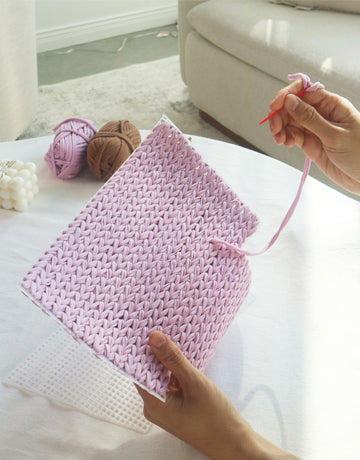

You've probably got a new kit on the table right now. The yarn looks cheerful, the canvas looks a bit mysterious, and the hook itself may seem oddly tiny for something that's meant to become a rug.
That mix of excitement and hesitation is completely normal. A latch hook rug looks complicated before you start, but the craft is built on one repeatable motion. Once your hands learn it, the whole project shifts from “How do I do this?” to “I'll just do a few more rows.”
Your Creative Journey Starts Here
Opening a latch hook kit feels a little like opening a puzzle and a bouquet at the same time. You've got bundles of colour, a gridded base, and the promise of a finished piece you can use. For beginners, that's part of the appeal. You don't need to draft a pattern or cut every strand yourself. You start with clear materials and build texture one knot at a time.

What I like most about this craft is that it meets you where you are. If you want a calm evening project, it works. If you want something hands-on that doesn't require memorising complicated stitches, it works for that too. You're making progress every time you pull one strand through the canvas.
A craft with older roots than most people realise
Latch hooking didn't appear out of nowhere as a modern hobby. In Canada, it belongs to a broader rug-making tradition that took root in the 19th century, especially in the Maritimes and Newfoundland and Labrador. Early makers often worked from necessity and used scraps. Later, the craft became more standardised in the 1930s, which helped make commercial patterns and kits possible, as described in this history of rug making from Messy Beast.
If you enjoy craft history, A History Of Rug Making gives helpful broader context for how rugs evolved across materials, methods, and everyday use.
Practical rule: You don't need to feel “artistic” to enjoy latch hooking. You need a printed canvas, a hook, and the willingness to repeat a simple motion.
Why beginners stick with it
Some crafts punish a shaky start. Latch hooking is more forgiving. If one knot looks a bit loose, the surrounding yarn often softens the difference. If you pause for a week, you can pick it up again without relearning everything.
That's why it's such a satisfying first fibre project. You're not just learning a technique. You're joining a long line of makers who turned plain materials into something warm, useful, and personal.
Unpacking Your Kit and Reading the Canvas
A latch hook rug kit makes more sense once you name each part. Most beginners get stuck not because the knot is hard, but because the materials look unfamiliar all at once.
What's usually in front of you
Here's the basic orientation:
| Item | What it does | What beginners often confuse |
|---|---|---|
| Latch hook tool | Pulls folded yarn through the canvas and closes over the strand | It's sometimes mistaken for a crochet hook, but it works differently |
| Printed canvas | Acts as the foundation and shows where colours go | The printed areas can look like decoration rather than instructions |
| Pre-cut yarn | Becomes the pile of the rug | New crafters sometimes think they need to trim every strand first |
| Legend or colour key | Matches symbols or colour blocks to yarn shades | It's easy to skip this and then place colours in the wrong area |
The smartest thing you can do before making a single knot is organise your yarn. Separate shades into small piles, bowls, or zip bags. If two colours look close in indoor lighting, check them beside a window before you begin.
How to read the canvas without second-guessing yourself
Think of the canvas as a map. Each square or printed area tells you where a certain yarn colour belongs. Some kits use blocks of colour. Others use symbols paired with a legend. In both cases, your job is the same. Match the yarn to the marked area and tie it into the correct grid space.
Beginners often ask whether they should follow the printed design exactly. If it's your first rug, yes. That removes one variable and lets you focus on the technique.
A good prep routine helps more than people expect:
- Flatten the canvas so it sits evenly on your lap or table.
- Find the centre or a clear starting area before you begin.
- Group similar shades carefully if your design uses several tones of one colour family.
- Keep the legend visible instead of folding it under the canvas.
A few minutes of sorting saves a lot of unpicking later.
If you're still figuring out what tools and base materials belong to rug crafts more broadly, this guide to rug hooking supplies is useful for seeing the main pieces laid out clearly.
Two beginner mistakes worth avoiding
The first is rushing the setup. When yarn colours get mixed early on, the project feels harder than it is.
The second is treating the canvas like fabric rather than a grid. You're not sewing through random spots. You're working square by square, using the grid as your structure. Once that clicks, the whole project becomes much easier to read.
Mastering the Latch Hook Knot
The heart of a latch hook rug is one motion repeated many times. That's good news. You don't need a catalogue of stitches. You need one knot that becomes smooth through repetition.

The motion to remember
Use this sequence in your head: fold, push, wrap, pull.
- Fold the yarn in half.
- Push the hook through the chosen canvas grid with the latch open.
- Wrap or lay the two yarn ends over the open latch.
- Pull the tool back so the latch closes and catches the yarn, forming the knot.
That basic method is described in this latch hook guide from Craft Club Co. The same source notes that experienced makers can tie about 350 to 700 knots per hour, and a 100 x 150 cm rug with about 23,500 knots may take roughly 33 to 67 hours of active hooking time. That's a useful reminder that latch hooking is simple, but it isn't instant.
What your hands should feel
A proper knot should feel snug, not strangled. If you pull too tightly, the yarn can look pinched and the canvas may distort. If you pull too loosely, the strand may sit unevenly.
Watch for these cues:
- The loop sits neatly at the base of the yarn tuft.
- Both cut ends are fairly even after tightening.
- The canvas grid still lies flat instead of puckering.
If the hook catches awkwardly, slow down and check the latch. Most early mistakes happen because the latch didn't open or close fully.
Why beginners struggle for the first few rows
Your hands are learning a new path. That's all. The first row often feels clumsy because you're thinking about every micro-step. By the time you've repeated the motion across a section, your fingers usually start anticipating what comes next.
Here's a quick troubleshooting list:
-
Yarn slips off the hook
Keep both ends together and lay them diagonally over the open latch before pulling back. -
The hook won't pass easily through the canvas
Aim for the grid opening, not the threads of the canvas itself. -
Knots look uneven
Check whether you're folding each strand evenly before placing it on the tool. -
Your hand gets tired
Rest your wrist, change your sitting angle, and do short sessions instead of pushing through discomfort.
A realistic pace helps more than motivation quotes
Latch hooking becomes relaxing when you stop expecting fast results. A rug is built knot by knot, and that's the point. Put on a podcast, mark a small target for the session, and let repetition do the heavy lifting.
You don't need speed yet. You need consistency.
Bringing Your Design to Life
Once the knot feels natural, the design starts appearing almost unexpectedly. A patch of background turns into a border. A few colour changes suddenly look like petals, waves, or lettering. That's the stage where many people either find their rhythm or become overwhelmed by the remaining blank canvas.

Choose a working style that suits your brain
There isn't one perfect order for every rug. There are, however, a few dependable ways to stay organised.
- Work by colour if your design has large blocks. This cuts down on constantly switching yarn bundles.
- Work row by row if you lose your place easily. It gives you a visible path across the canvas.
- Work in small zones if the pattern is busy. A corner or section feels easier to complete than the whole rug.
For detailed designs, many beginners enjoy looking through examples of hooked rug patterns before choosing a workflow. You start noticing which layouts are friendlier for colour-blocking and which are easier tackled in sections.
Keep the project manageable
A few practical habits make a big difference:
| Habit | Why it helps |
|---|---|
| Store each colour separately | Reduces tangles and mix-ups |
| Roll or fold unused canvas loosely | Keeps the work area tidy |
| Check the front often | Lets you spot missed spaces early |
| Finish one small area per session | Builds momentum without pressure |
A video can help if you want to see pace and hand position in action:
Some crafters like to outline key shapes first, then fill them in. Others prefer steady rows. If your method keeps you accurate and calm, it's the right one.
The big shift here is mental. Don't stare at the unfinished whole. Look at the next cluster of squares. A latch hook rug gets finished through small, ordinary sessions, not one burst of heroic concentration.
Finishing Your Rug for a Professional Look
The hooking may be complete, but the rug isn't finished until the edges are secure. This is the step many tutorials rush through, even though it changes how durable and polished the final piece feels.

Two common finishing methods
According to the guidance on this Shillcraft latch hook rug kit page, a clean finish matters for durability. Some makers fold and stitch the canvas edge. Using dedicated rug binding can create a more durable and professional result, especially for rugs that will get foot traffic.
Here's the practical comparison:
-
Fold-and-stitch
Good for wall hangings, cushion fronts, or rugs that won't be handled heavily. It's simple, but it asks for careful sewing. -
Rug binding
Better when you want a cleaner edge with stronger protection against fraying over time.
What to do before binding or stitching
Trim only the obvious strays. Don't give the whole rug an aggressive haircut. The goal is to tidy uneven pieces, not flatten the texture you worked so hard to build.
Then check the perimeter:
- Look for empty edge spaces
- Make sure the canvas margin is even
- Decide whether the piece will hang, sit on furniture, or go on the floor
That last point matters. A decorative piece can get away with a simpler finish. A floor rug needs more protection.
If you ever plan to sell handmade textile work, learning finishing standards early is smart. Even if you're not there yet, this guide on how to launch a successful shop on Etsy is useful for understanding how presentation affects perceived quality.
For beginners choosing their first all-in-one project, comparing kit structure can also help. This overview of a rug making kit gives a good sense of what to expect from packaged materials and finishing needs.
Your Latch Hook Questions Answered
How do I clean a latch hook rug
Treat your rug the way you would treat a knitted sweater. Gentle handling keeps the fibres fluffy and the shape intact.
Start by shaking out loose dust. If one area gets dirty, spot clean it with a damp cloth and a small amount of mild soap, then blot carefully. Rubbing pushes the yarn pile flat and can make that patch look worn before the rest of the rug.
If your kit maker included care instructions, follow those first. Some yarns handle light cleaning better than others. If pets share your space, placement matters too. This practical guide for pet owners on home rugs has useful habits that also make sense for handmade pieces.
What if I notice a mistake several rows later
This happens to almost every beginner.
Start by asking one question. Will the mistake change the picture in a way you can see from a normal distance? If yes, fix it. If no, you may be better off leaving it alone and finishing the project with your momentum intact.
To correct it, slide the hook under the wrong piece, loosen the knot carefully, pull the yarn out, and rework that square with the right colour. Go slowly so you do not stretch the canvas hole. The canvas is sturdy, but repeated tugging in the same spot can weaken it.
A simple rule helps here: correct mistakes in borders, outlines, faces, letters, and large colour areas. Tiny colour swaps hidden in textured sections usually disappear once the whole rug is finished.
What can I do with leftover yarn
Save every bit until the rug is completely finished.
Leftover yarn is your repair kit. It helps with practice knots, filling thin spots you only notice at the end, testing trimming decisions, or patching wear later if the rug gets regular use. Small bundles are also handy if you decide to make a matching mini piece, a tassel, or a simple sample square before starting your next kit.
How long does a latch hook rug take to finish
Beginners often want a number here, but the honest answer depends on the rug size, the number of colour changes, and how often you stop to check the chart.
A small beginner kit may fit into a few relaxed crafting sessions. A larger or more detailed design can stretch across weeks. Progress usually feels slow at first because your hands are still learning the motion. Then something clicks, and each row starts moving faster. That learning curve is normal.
If you want the project to feel manageable, set a tiny goal such as one colour block, one row, or fifteen minutes at a time. Latch hook rewards steady repetition more than speed.
Why does my rug look uneven
Uneven texture is common in first projects, and it does not always mean you did anything wrong.
Some pieces stick up because the yarn has shifted, some because knots were pulled tighter than others, and some because different colours or fibre batches reflect light differently. Before you trim anything, spread the rug flat, pat the pile with your hand, and look at it from a short distance. Many “problems” settle down once the whole surface is complete.
If a few strands are much longer than the rest, trim only those obvious outliers. Small variations are part of the soft, textured look that makes latch hook appealing in the first place.