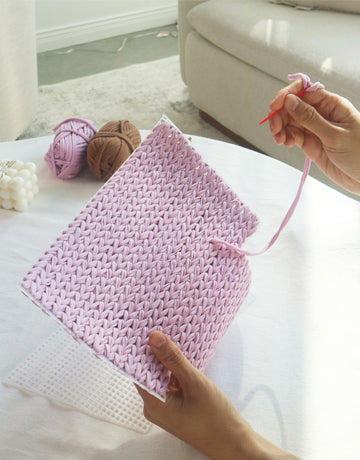

You've finished the knitting. The last stitch is cast off. You hold up your sweater or scarf, admire it for three seconds, and then turn it over.
There they are. A small jungle of yarn tails.
If weaving ends knitting feels like the least glamorous part of the project, you're not alone. Many beginners worry they'll do it wrong, make the fabric lumpy, or watch the tails creep back out after the first wash. The good news is that weaving in ends is learnable, logical, and much less mysterious once you match the method to the fabric in front of you.
The trick isn't memorising one “best” technique. It's learning how to decide. Stockinette behaves differently from ribbing. Sticky wool behaves differently from smooth cotton. Intarsia needs a different plan than a plain scarf. Once you understand that, finishing gets much easier.
The Final Step to a Flawless Knitted Project
I still think the most frustrating version of this is a striped project. The knitting itself feels cheerful and fast, and then the finished piece looks like it has whiskers. You want to wear it, gift it, or block it, but first you have to deal with all those loose tails.
That's the moment when finishing stops feeling optional. A beautifully knit garment can still look unfinished if the tails are bulky, visible, or insecure. A neatly woven end, by contrast, disappears into the fabric and lets the stitches take the credit.
This is also part of knitting's long practical tradition. As historical research on American weaving and knitting notes, the patent of the power loom in 1785 helped push textile production toward industrial mills, and by the early 1900s handweaving was nearly extinct in places like California. That shift left more room for portable, loom-free crafts like knitting, especially for settlers making practical items such as socks and mittens. Finishing skills mattered because handmade knitting had to hold up in daily life.
Weaving in ends isn't cleanup. It's the last part of construction.
When you start seeing it that way, the task changes. You're not hiding a mistake. You're anchoring the fabric so it stays beautiful after wear, washing, stretching, and use.
What a good woven end should do
A properly finished end should do three jobs at once:
- Stay secure so the tail doesn't wriggle loose later
- Stay discreet so the front of the fabric still looks clean
- Preserve the fabric so ribbing still stretches and textured stitches still sit properly
Beginners often focus only on “make it invisible.” That matters, but invisibility without security is disappointing. The tail looks perfect today, then peeks out next week.
The mindset shift that helps most
Instead of asking, “What's the best weaving method?” ask these three questions:
- What stitch pattern am I working with
- How slippery is this yarn
- Will this area stretch, rub, or get washed often
That simple framework will guide almost every choice in this article.
Gathering Your Essential Finishing Tools
A small finishing kit saves a surprising amount of annoyance. You don't need a drawer full of gadgets. You need a few reliable tools that make controlled, tidy movements possible.

The tools worth keeping together
-
Blunt tapestry needle
This is the workhorse for most knitting finishes. A blunt tip slides between stitches instead of piercing random fibres, which helps you follow the structure of the fabric more neatly. -
Bent-tip needle or straight needle
A bent-tip version can make it easier to scoop under stitches in tight areas. A straight one feels more precise for longer paths. Neither is universally better. It comes down to what feels steady in your hand. -
Small sharp scissors
Clean trimming matters. Dull scissors can leave fuzzy ends, and fuzzy ends are harder to assess accurately. -
Measuring tape or a small ruler
Handy when you're learning how long a woven path should be. New knitters often cut too soon.
Practical rule: if a tool helps you move the yarn with control, it's useful. If it adds fuss without improving the result, skip it.
If you enjoy assembling tidy project kits, the same logic applies across crafts. Makers who like organised notions might also appreciate quality quilting supplies for makers, especially if you enjoy keeping thread, scissors, and finishing tools sorted by project.
Build a simple finishing pouch
Keep these together in a tin, pouch, or small zip case. Add your yarn labels if you can. Matching the exact fibre later is easier when the band is still nearby.
If you're still building your toolkit from scratch, a beginner knitting kit guide can help you sort the true essentials from the nice-to-haves.
Core Weaving Methods for Everyday Knitting
Most projects only need three methods. If you learn these and understand when to use each one, you'll be able to finish the majority of scarves, hats, sweaters, and blankets without guessing.

Duplicate stitch for stockinette
This is the method to reach for when the right side is smooth stockinette and you want the tail to vanish. You're basically tracing the shape of existing knit stitches with the tail, so the yarn blends into the structure instead of sitting on top of it.
Canadian knitting guild benchmarks reported that duplicate stitch ranked highest for invisibility in stockinette, with a 92% success rate in preventing unraveling after five machine washes when worked for a minimum of one inch. The same guidance notes that splitting plies on slippery yarns helps reduce bulk and improve grip, according to this finishing reference on weaving in ends.
How to do it
- Thread the tail onto a blunt tapestry needle.
- Start on the wrong side and bring the needle to the right side at the base of a knit “V”.
- Slide the needle under the two top strands of the stitch above.
- Return to the base of the original stitch, following the same path a knit stitch would take.
- Repeat through several adjacent stitches.
- Turn and travel back through nearby structure on the wrong side if you need extra hold.
Think of it as tracing the heart of the stitch. You are not inventing a new line. You are borrowing the line that's already there.
Horizontal weaving for garter and textured fabric
Garter stitch, seed stitch, and other textured fabrics give you natural little ridges and bumps to hide yarn in. Here, a direct duplicate stitch often isn't necessary. The texture itself does some of the camouflage work.
Use the wrong side if one exists, or choose the least visible channel within the ridges. With garter, many knitters find that following the purl bumps or slipping the tail through the bumpy ridges gives a tidy result.
What to watch for
- Don't pull tight or the ridge will pinch inward
- Don't weave in a perfectly straight, obvious line if it creates a visible track
- Do stretch the fabric gently after weaving so the stitches settle
Vertical weaving for ribbing and columns
Ribbing is where many beginners get annoyed. A tail that looks hidden while the cuff is relaxed can flash into view as soon as the fabric stretches. That's why ribbing usually needs a method that respects the vertical structure.
Work with the columns, not against them. A vertical path hides better and interferes less with elasticity.
| Method | Best For | Key Benefit |
|---|---|---|
| Duplicate Stitch | Stockinette | Mimics existing stitches for an invisible finish |
| Horizontal Weave | Garter, seed stitch, textured fabric | Tucks into ridges and bumps with minimal fuss |
| Vertical Weave | Ribbing, columns, selvedges | Preserves stretch and reduces visible bulk |
A quick decision framework
If you freeze when holding the needle, use this shortcut:
- Smooth knit “V” shapes on the front call for duplicate stitch
- Bumpy, textured ridges usually prefer a horizontal or gently meandering path
- Stretchy columns need vertical weaving so the fabric can still expand
If the fabric stretches up and down, weave up and down. If the fabric reads as rows, weave with the rows.
This is also why one generic tutorial can feel confusing. The wrong method isn't always badly taught. It may be mismatched to the fabric.
For knitters who also make other yarn projects, understanding how fabric structure controls finishing can sharpen your eye across crafts. The same habit of reading the stitches helps in fastening off crochet neatly, even though the fabric behaves differently.
Smarter Techniques for Special Situations
Once the basics feel comfortable, a few specialised methods can save time and reduce finishing stress. These aren't mandatory for every project, but they're brilliant in the right situation.

Weave as you go for stripes and colour changes
If you dread a pile of tails at the end, this is the first skill to add. Instead of leaving every tail for later, you trap it into the fabric while knitting the next stitches.
That approach is especially handy in stripes, small colour changes, and repeated joins. It keeps the finishing load manageable because you solve the problem while the project is still on the needles.
The method is simple in principle. Lay the old tail along the wrong side of the fabric, then knit the new stitches while catching that tail in the path of the working yarn. Keep checking the front so the trapped section doesn't shadow through.
Russian join and splicing
These are joining methods rather than classic end weaving, but they belong in the conversation because they can reduce how many tails you create.
A Russian join nests yarn ends into each other so you can continue knitting with one joined strand. It can work nicely when colour and fibre cooperate, though it can add bulk in finer or very smooth yarns.
Splicing works best with fibres that want to cling to themselves. If the wool feels grabby and non-superwash, a felted join can be tidy and strong. If the yarn is slick, heavily treated, or plant-based, this usually isn't the best route.
A better plan for intarsia
Intarsia creates lots of tails, and that's where many knitters lose patience. According to this intarsia finishing tutorial, 55% of knitters report frustration with end-weaving in intarsia, and splitting tails then weaving them bidirectionally into solid-colour background areas can reduce visibility by 40% compared with standard methods.
That advice matters because intarsia isn't just “more tails.” It's a different finishing problem.
Why standard advice often fails in intarsia
- Seam-based hiding isn't useful because many motifs sit in open fabric with no seam nearby
- Straight-line weaving can create shadowing behind lighter colours
- Bulk builds quickly when several tails gather in one small area
Try this approach instead:
- Separate or split the tail if the yarn structure allows it.
- Identify a nearby solid-colour zone rather than the edge of the motif.
- Weave one part in one direction and the other part in another direction.
- Keep the path inside matching colour areas whenever possible.
If colourwork is one of your sticking points, it also helps to review changing colours in crochet cleanly. The fabrics differ, but the habit of planning joins before they pile up transfers well.
Troubleshooting Common Weaving Woes
Most weaving problems look dramatic and turn out to have simple causes. Ends pop out. Ribbing goes stiff. A colour change leaves a ladder. None of that means you're bad at finishing. It usually means the method and the yarn weren't working together.

When ends keep popping out
This is the complaint I hear most often, especially with woolly yarns that don't behave like the smooth tutorial yarn in many demonstrations.
A Canadian Ravelry survey found that 68% of knitters struggle with end security in high-wool-content projects, and a vertical duplicate stitch can grip fibres 25% tighter than the commonly recommended diagonal weave, according to this discussion of ends that won't stay put.
That doesn't mean diagonal weaving is always wrong. It means you should question the common assumption that one path suits every yarn.
Some yarns need more friction than a standard weave provides.
If your ends repeatedly emerge after blocking or wear, try changing the path before blaming your tension. Vertical duplicate stitch often gives wool-rich yarns more to hold onto.
When the fabric looks bulky or puckered
This usually comes from one of three things:
- The tail is too thick for the route you chose
- You doubled back over the exact same line
- You pulled the needle through too firmly
For bulky yarn, spread the tail through a longer path or split the plies if the yarn allows it. For smooth yarns, use a route with more turns and more contact with surrounding fibres.
A short visual walk-through can help if you're a hands-on learner:
When ribbing loses its stretch
This one feels unfair because the finish can look tidy while the cuff suddenly stops behaving like ribbing. The cause is usually horizontal weaving across a fabric that wants to expand vertically.
Use these checks:
- Test the area with a gentle stretch before trimming
- Move into a knit or purl column rather than across both
- Avoid anchoring the tail across the “hinge” where the rib opens
When to trim the tail
Don't rush this. Leave the tail in place until after blocking, especially if you're not fully sure the path is secure. Blocking lets the stitches settle and shows you whether the woven route is visible, tense, or likely to peek out.
Trim after the fabric has relaxed into its final shape, not before.
Your Finishing Flourish and Next Steps with Stitch Mingle
You pull on a finished sweater, turn it inside out for one last check, and everything stays put. No little tail peeking through a ribbed cuff. No bulky spot at the side seam. That calm, tidy finish is what good weaving gives you.
Skill is not memorizing one "correct" method. It is choosing a method that suits the fabric in front of you. Wool-rich yarn usually forgives a simple woven path because the fibres grip each other. Slick yarn often needs a longer route or a path with more direction changes. Ribbing asks for stretch. Dense stitch patterns can hide more. Once you start making those choices on purpose, your finishing gets more reliable and much less stressful.
Give yourself one final check before trimming close. Look at the project the way a knitter and a future wearer would. Stretch cuffs and hems. Smooth flat areas. Turn the piece over and check whether any tail line shows from the right side. If an end still feels uncertain, leave a little extra length and revisit it after the fabric has rested.
A simple rule helps here. Match the method to the project, not the other way around.
| Resource | Link |
|---|---|
| Beginner kits and creative supplies | Browse Stitch Mingle |
| Blog for project guidance | Read the Stitch Mingle blog |
| DIY kits for giftable makes | Explore Stitch Mingle collections |
If you want another project to practice on, Stitch Mingle offers beginner-friendly kits, polished supplies, and clear tutorials that help you build finishing confidence one project at a time.